`
Travelin' Cousins
  • Home
  • About
    • Our Story
    • Media Kit
    • Press >
      • October 2018 Press
    • Contact
  • The "Almost" Daily Scoop
  • Travel Articles
    • Travel Adventures Articles
    • Throwback Thursdays >
      • Elisa's Throwback China Trip Adventure
    • Foodie Fridays
    • Travelin' The NYC Outer Boroughs with Elisa
    • Walt Disney World Wednesdays
  • Things To Do
    • Entertainment Reviews
    • New York Area
    • Southern California Area
  • Where to Stay and Things to Do
  • Where to Dine Vegan
  • Fun Fact & Travel Trivia Articles
    • Fun Facts List Directory
  • Tanya's Photo Gallery
    • Pictures from Auschwitz/Birkenau - WARNING: Mature Content/Depressing Images
  • Elisa's Photo Gallery
  • Travel Tips
    • Know Before ya Go

Travelin' The NYC Outer Boroughs with Elisa

Explore the history, culture and dining in The Bronx, Brooklyn, Queens, Staten Island and Long Island with Elisa!

LEARN ABOUT THE "OTHER" BOROUGHS

Historic Stony Brook Grist Mill -   Long Island's Only Working Mill

4/30/2018

0 Comments

 
Picture
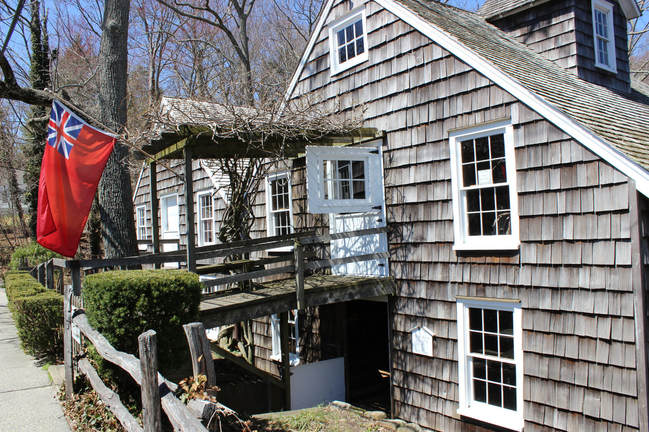
The Stony Brook Grist Mill (c) travelincousins.com
I am not going to lie, before I visited the Stony Brook Grist Mill, I really had no idea what it did or why it was so important.

After my visit and tour through the mill and around the grounds, from our exceptional tour guide, Richard, I feel rather enlightened and a whole heck of a lot more educated about grist mills and their necessity in centuries gone by.

Located in the Hamlet of Stony Brook, in the Town of Brookhaven, is Long Island's only working grist mill, which is listed on both the National and New York State Register of Historic Places.  Planning a full day for me and my girls to investigate Stony Brook, the Grist Mill was one of the highlights of our itinerary.
Picture
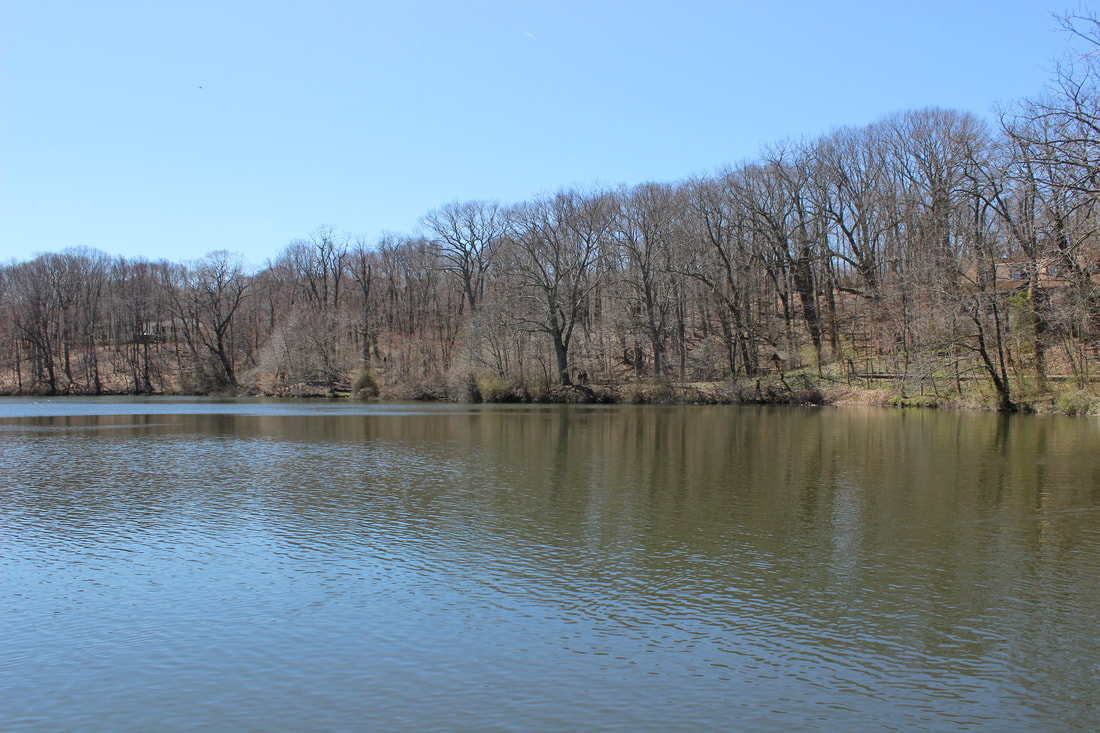
T. Bayles Minuse Mill Pond and Park in Stony Brook, across from the Stony Brook Grist Mill (c) travelincousins.com
Picture
The weather could not have cooperated more, on what was one of the nicest Spring days yet this year.  Located off Main Street, the Grist Mill building is an unassuming, modest cedar shake edifice opposite T. Bayles Minuse Mill Pond and Park.

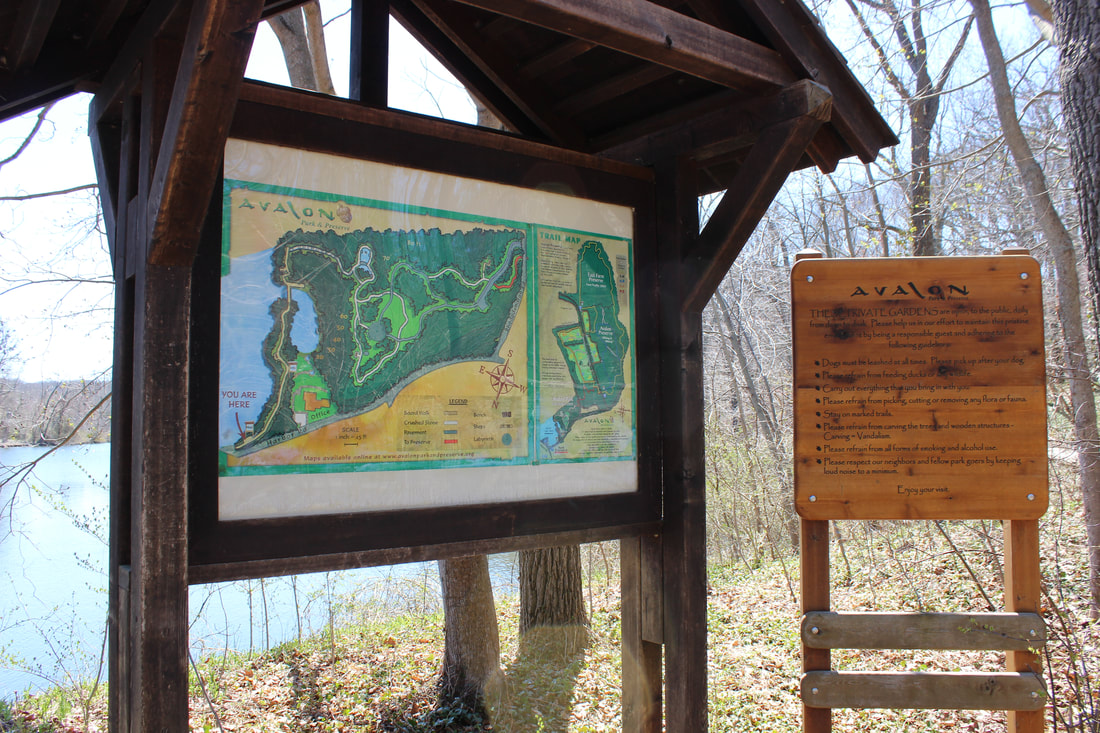
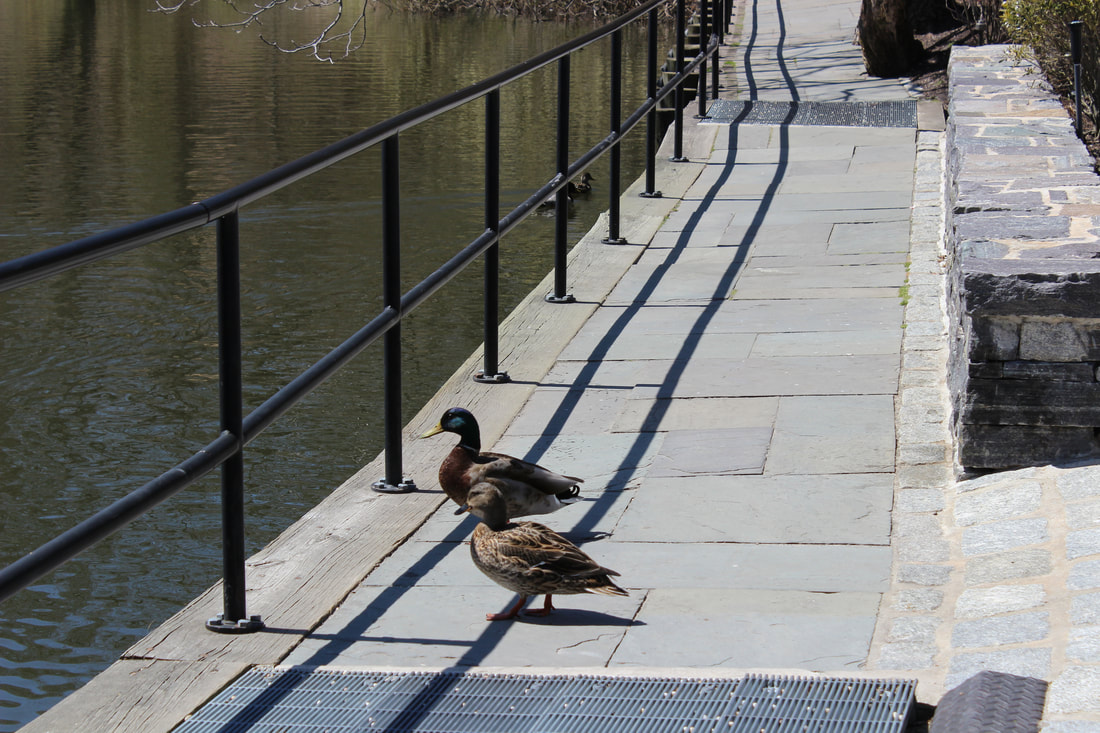
Just a gorgeous place to be on a sunny day, I strolled about the pond and the adjacent Avalon Park & Preserve, taking photos of this picturesque setting and its waterfowl and wildlife inhabitants that roamed about, awaiting for the opening of the Grist Mill.

​No reservations were needed for the mill tour, and we were lucky enough to get a one-on-one private showing of this nearly 300 year old landmark.  Our exceptionally knowledgable guide, Richard brought us back in time to the origins of the mill, the historic context in which it served the community and a perspective on life for the early settlers.
Picture
Some of the ducks I met walking along the pond (c) travelincousins.com
Picture
Entrance to Avalon Park & Preserve across from Grist Mill (c) travelincousins.com
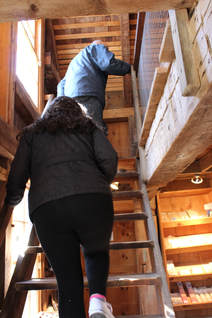
PictureGianna following Richard, our tour guide, up to the 3rd Floor of the Grist Mill (c) travelincousins.com
So what is so important about a grist mill? Well, in the early days of the settling of our country, we need to remember that there did not exist the same conveniences that we enjoy today.  As Richard, our tour guide put it, "you couldn't just run down to Starbucks to get a croissant."  

People grew their food, harvesting and preparing it themselves.  Today, we take for granted the fact that we can go down to the grocery store and buy a loaf of bread, or prepared food.

Grains like corn, wheat, rye and barley, were an important part of their food supply and when they were harvested, they couldn't really do much with them, until they were "milled" into flour.  I think that just about underscores the necessity and importance of a grist mill during that time.

Three centuries ago, in order for a town and its people to survive and thrive, there was a necessity for a grist mill and a blacksmith, which, as a result, were generally the wealthiest folks in the town. The miller, for example would get one-tenth of the ground flour as his payment from the farmers and anyone else having their grain milled. 
Picture
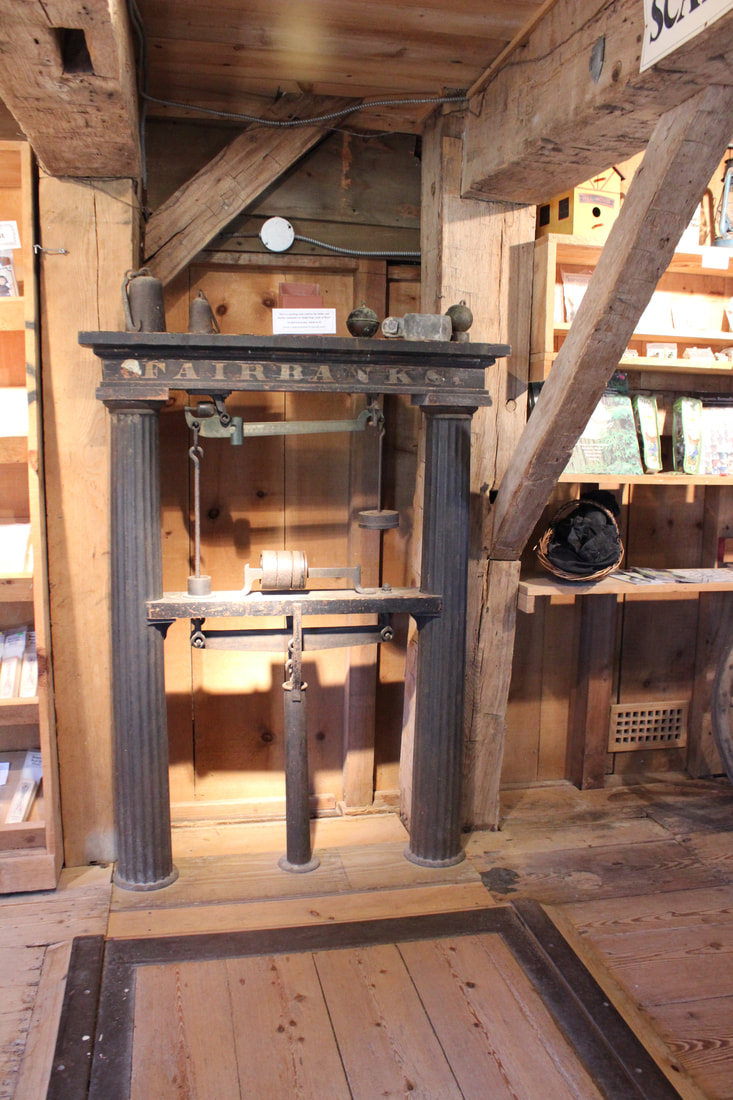
The grist mill scale, where the flour was weighed (c) travelincousins.com
Picture
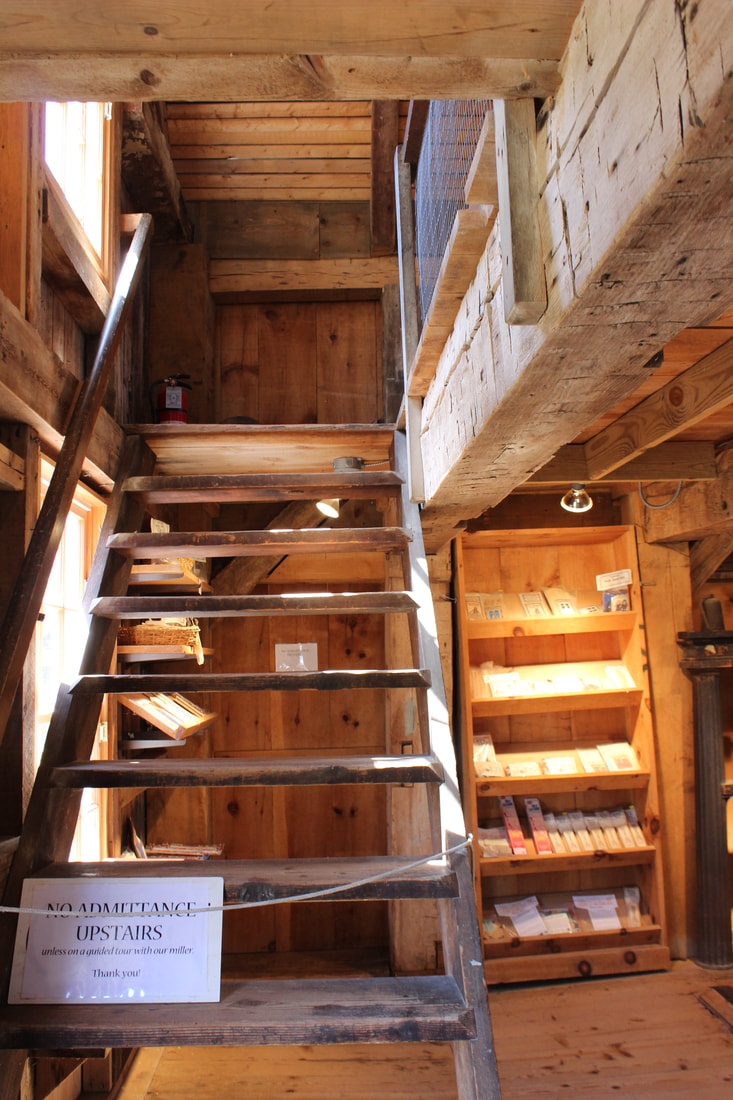
Steps leading up to the top floor - third level of the mill (c) travelincousins.com
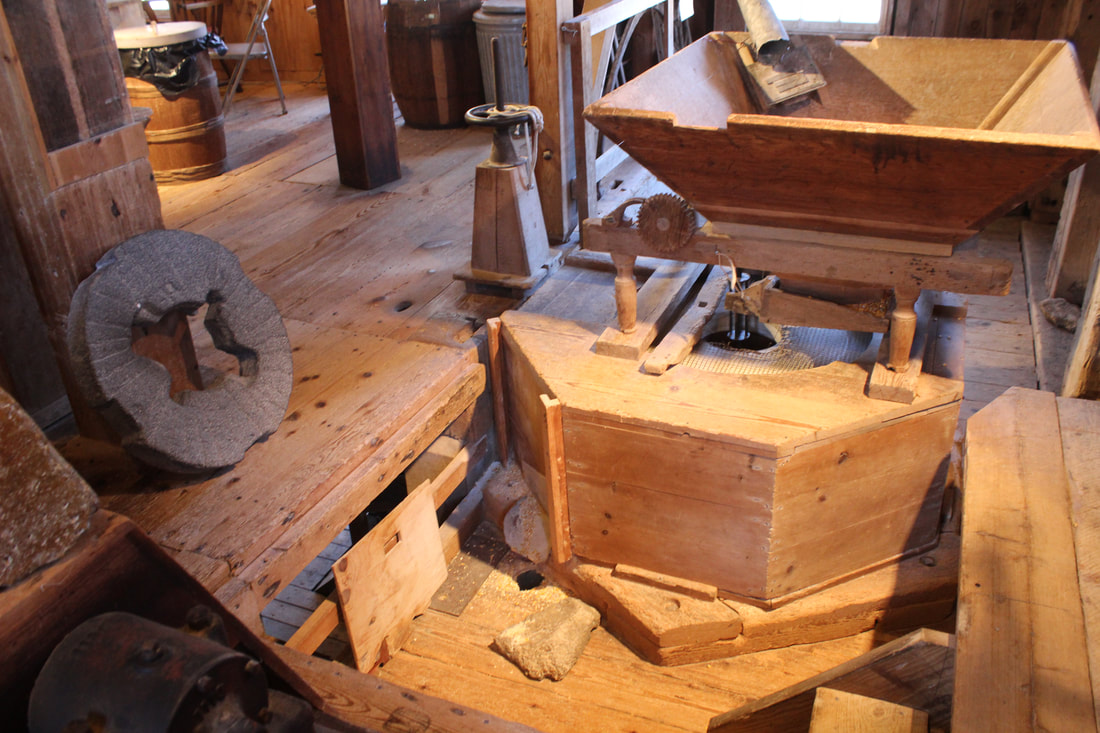
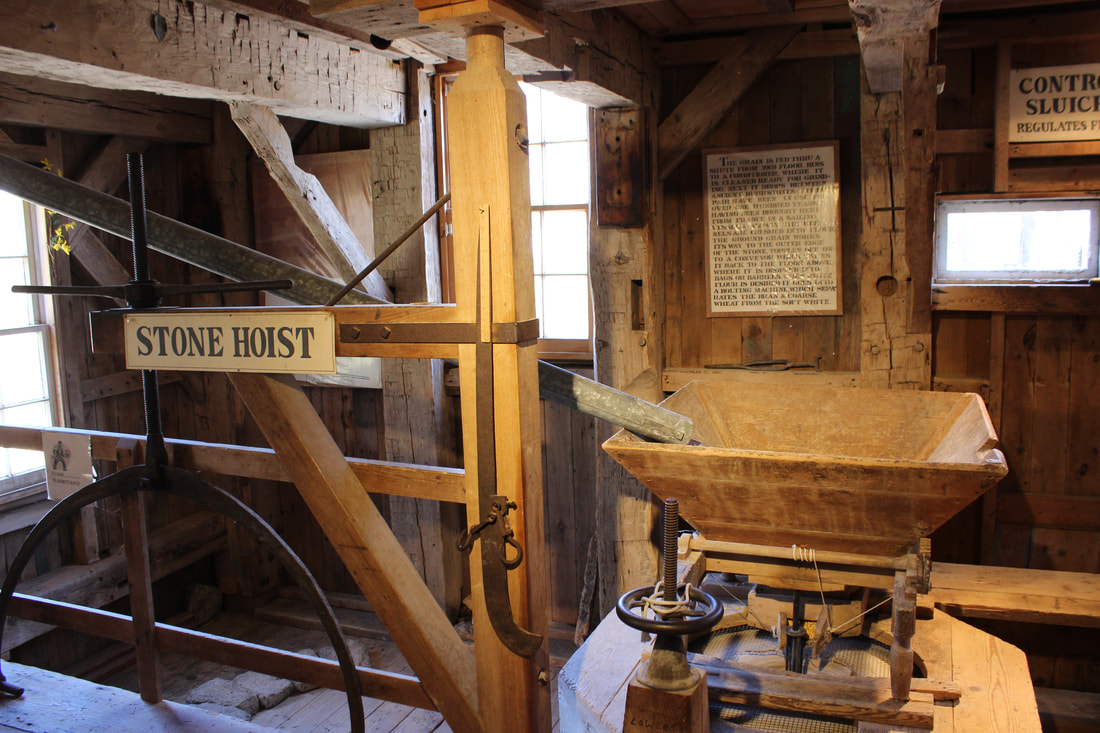
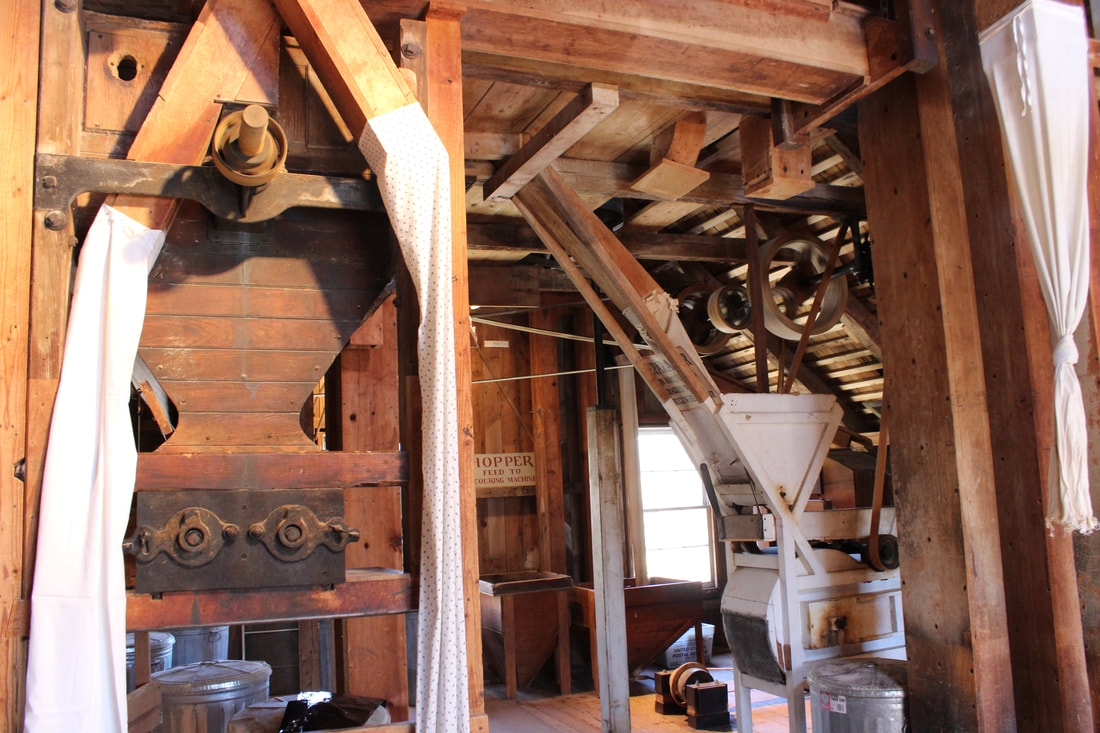
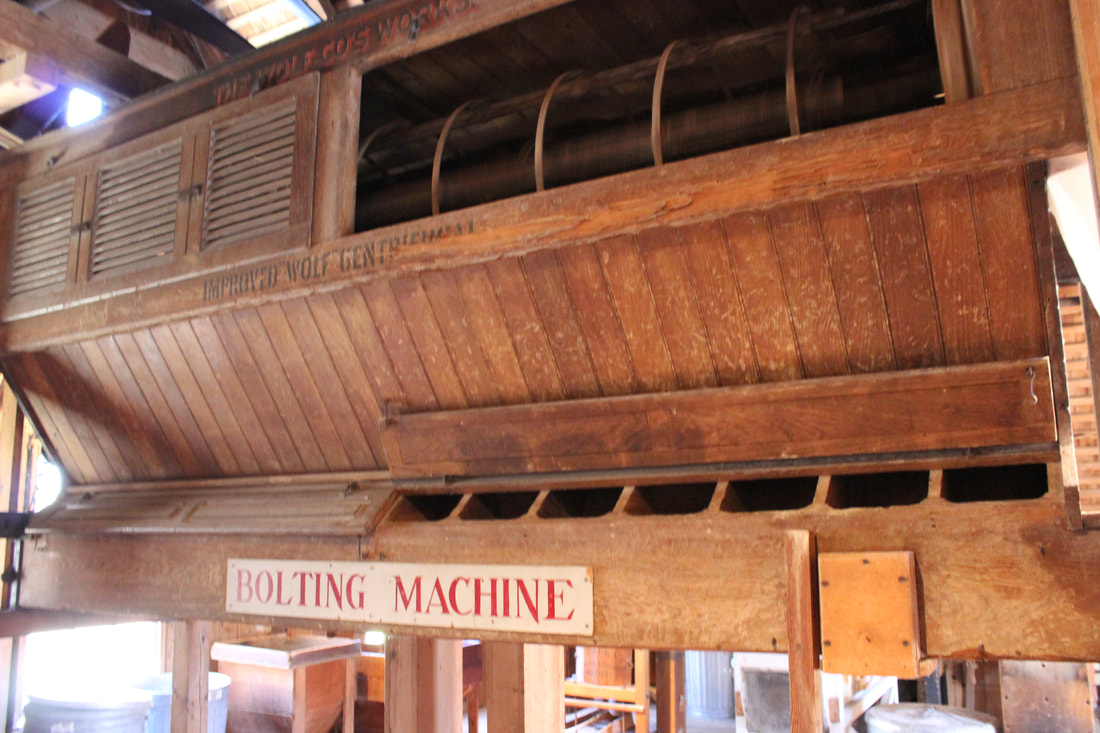
Our visit took us to all three levels of the mill, from the basement, where the grains were loaded to be milled, to the second floor or ground floor level, where they were ground by millstones, weighing up to one ton each; and finally up to the third floor to see the bolting process, where the sifting takes place to separate the flour from the leftover bits.  The flour would go to the customer and the leftover bits would become feed for the animals.
Picture
The grains come through the pipe into the giant bowl, where they pass through and are ground up by large stones that weigh about a ton each (c) travelincousins.com
Picture
Third floor - Bolting process (c) travelincousins.com
Picture
After it is ground, it goes up a vacuum tube to the 3rd floor to the bolting area where the flour is separated or sifted from the larger pieces, which were used for feed for farm animals (c) travelincousins.com
Picture
(c) travelincousins.com
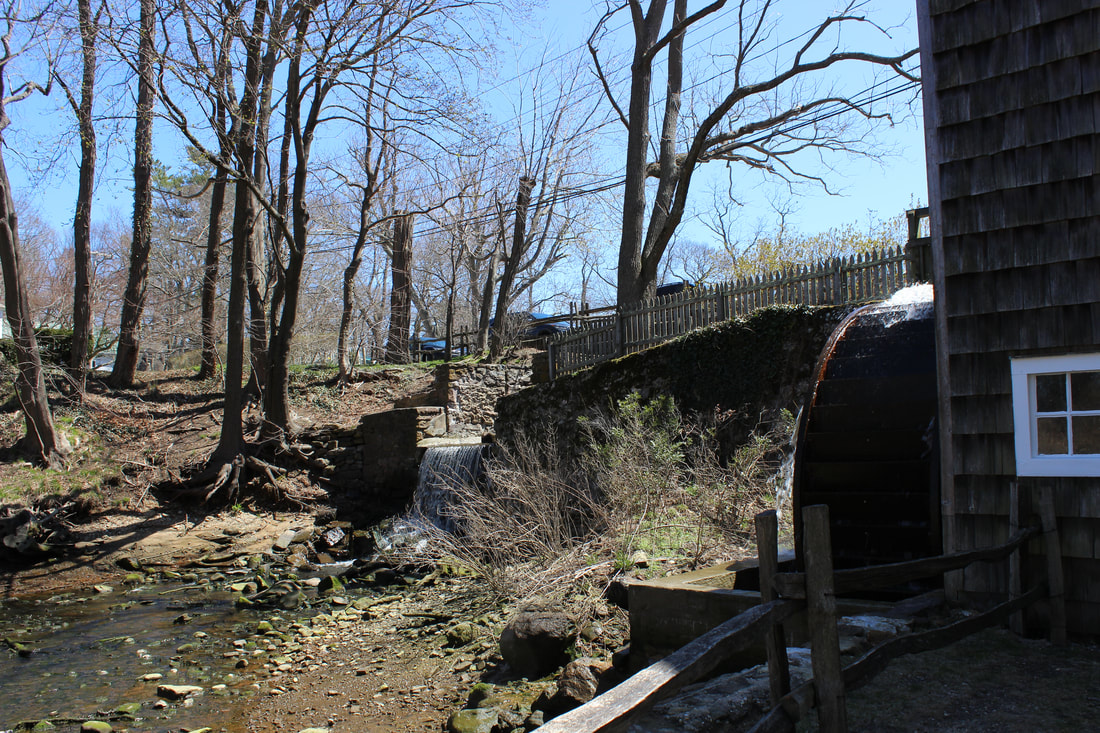
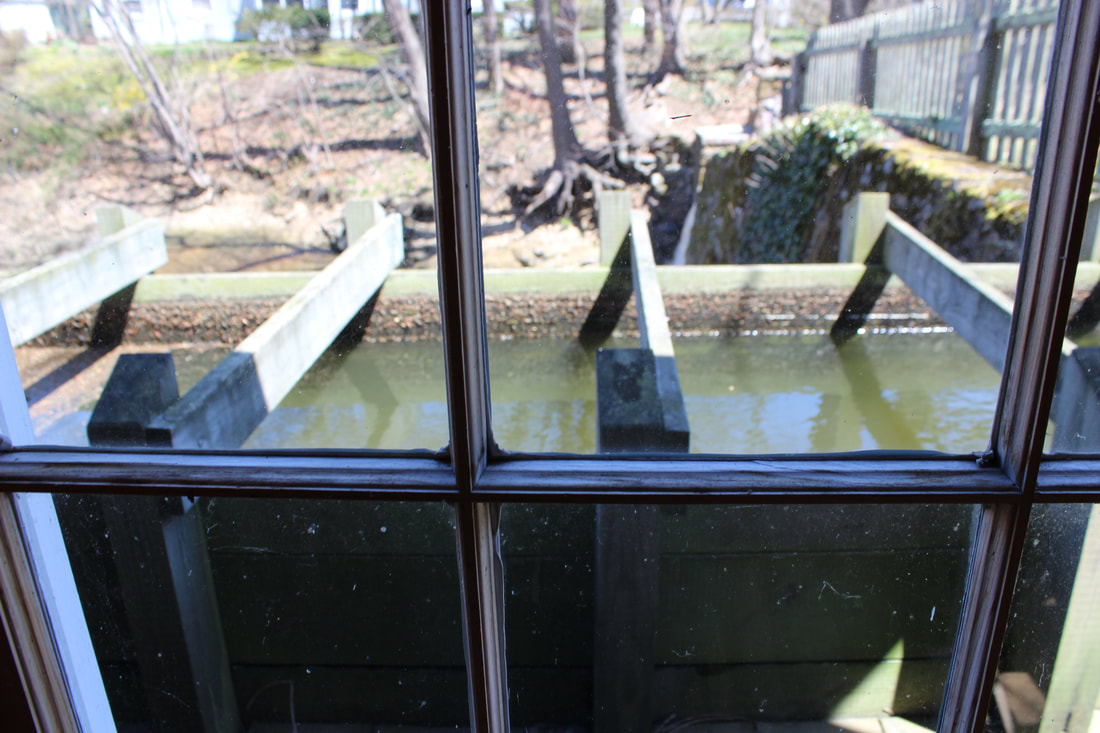
The entire mill and all of the machines are powered by water. Water from the millpond across the street flows under the street to the wheel, which powers the mill. It turns a series of gears and wheels, which turns the huge millstones, which in turn crushes and grinds the corn, wheat, rye or barley.

The mill backs up to the Stony Brook, which connects to the Stony River, by which ships would travel in order have their grain ground at the mill. ​An excellent location in those days for saving traveling time that would otherwise have to be brought by horse and carriage. (Incidentally, it is the Stony Brook from where this hamlet derived its name!).
Picture
Water from the millpond across the street flows under the street to the wheel to power the mill (c) travelincousins.com
Picture
The turning wheel next to the building. The excess water run-off from the pond can be seen to the left, to keep the pond level (c) travelincousins.com
Picture
The shallow Stony Brook from Stony Brook Harbor where ships would sail to bring their grains to the mill (c) travelincousins.com
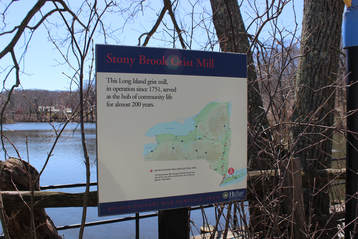
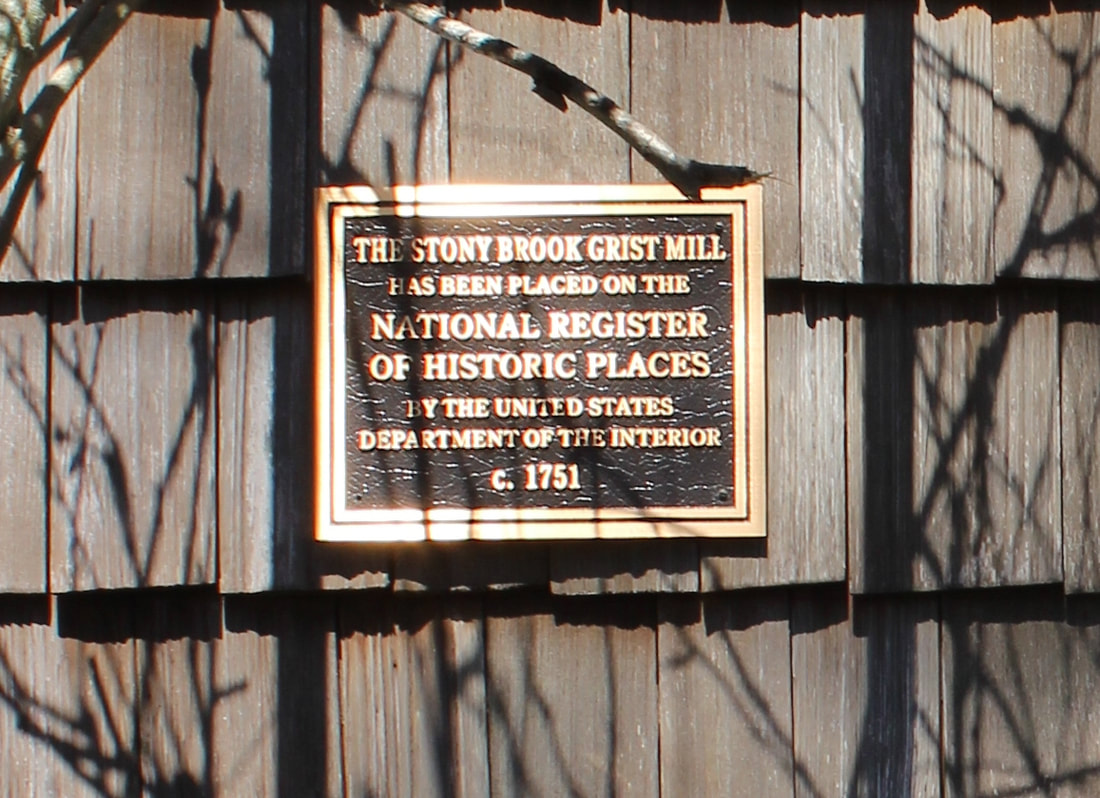
I'd like to share two bits of historic information.  First, you may have noticed the photos above, feature two signs outside the mill; one stating that the mill has been in operation since 1751 and another, a marker denoting the site where Adam Smith built the Stony Brook Grist Mill in 1699.  Two different dates for the same mill.

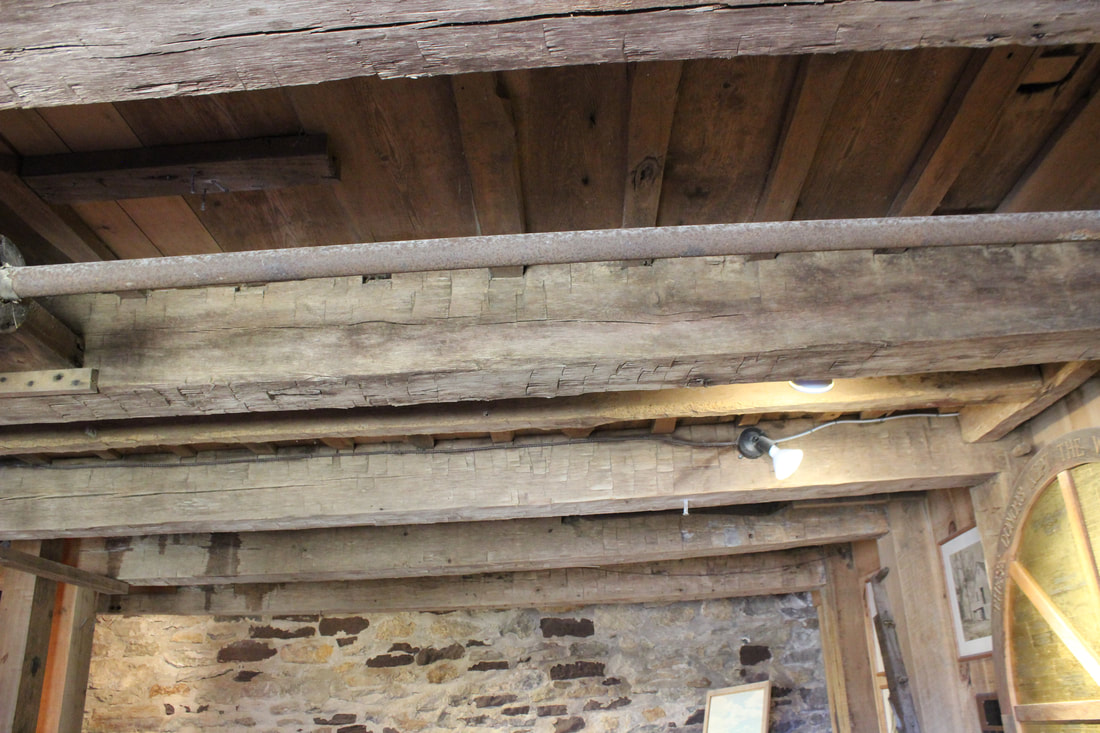
Well Adam Smith did indeed build the mill in 1699, but, unfortunately, a flood washed it away and required a new one to be built by his son in the current location in 1751.  Richard, our tour guide advised us that many of the original beams from the first mill were used and still part of the framing on the current structure.  These beams are massive and it is fascinating to behold the hand cut saw marks in the wood.
Picture
Original beam used in the current structure built in 1751 from the original grist mill built in 1699 by Adam Smith (c) travelincousins.com
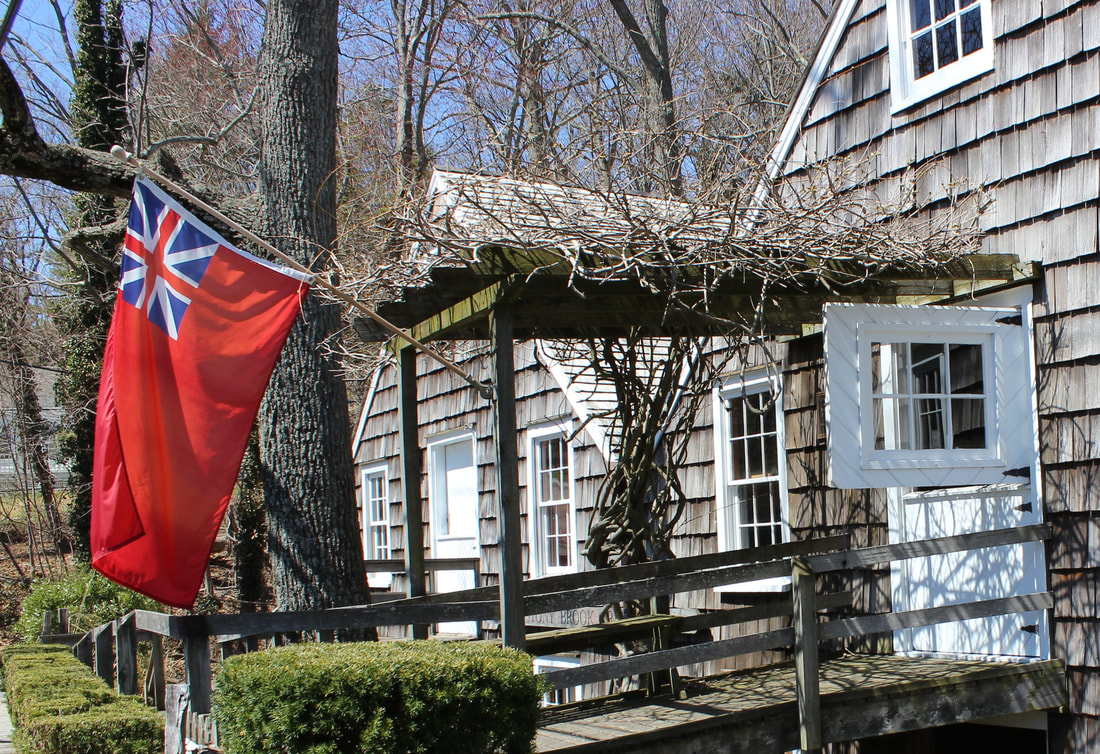
The second bit of trivia concerns the flag hanging outside the Grist Mill. ​This flag is called the British Red Ensign. It came to America in the 1620's. In 1707, this flag was flown by the colonists and during the beginning of the Revolutionary War. This flag would have been in front of the mill when it was first built.
Picture
The British Red Ensign Flag flown in the colonies (c) travelincousins.com
The Stony Brook Grist Mill had over two dozen owners through the years since 1751, and the last person to take ownership was Ward Melville, who bought it in 1947 and gave it to the Stony Brook Community Fund in 1952, which is now the Ward Melville Heritage Organization. ​
Picture
​In the late 1960’s The Stony Brook Museums opened the Mill. In 1990, it was listed on The National Register of Historic Places. ​
Picture
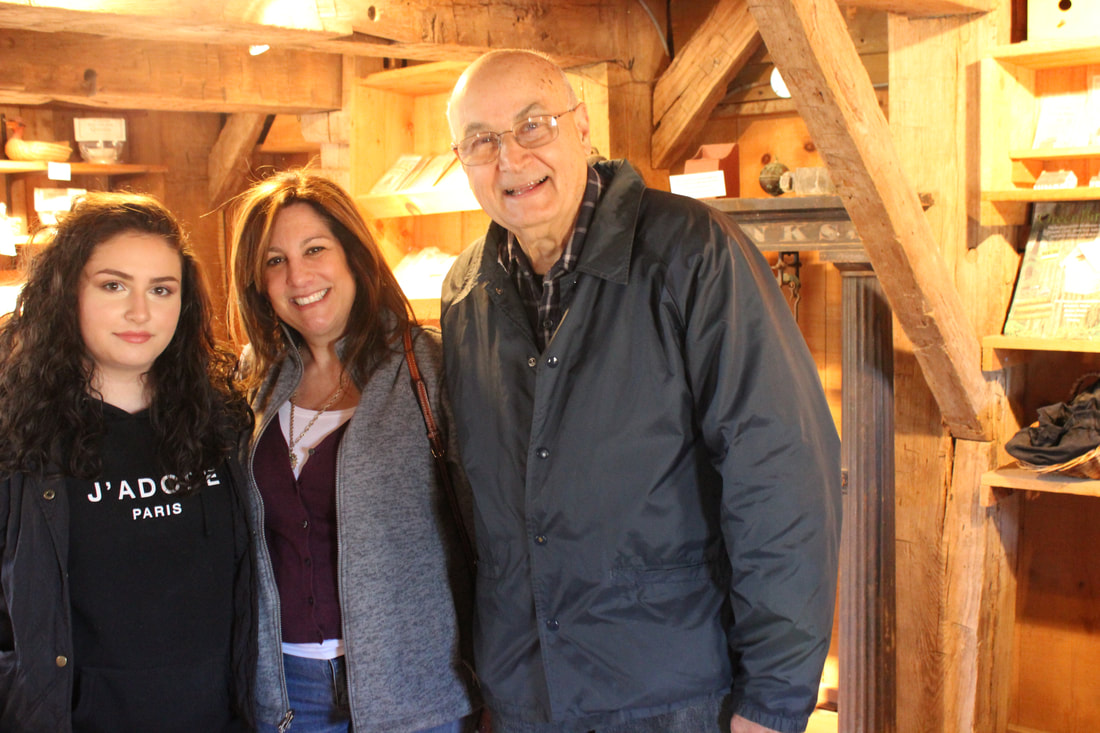
Gianna, me and Richard, our Stony Brook Grist Mill tour guide (c) travelincousins.com
I highly recommend visiting if you haven't already done so.  It's a charming bit of American history!

-Elisa
 
For Your Reference
Stony Brook Grist Mill
100 Harbor Road, Stony Brook, NY 11790
(631) 751-2244
Saturday - Sunday : 12:00pm - 4:30pm
0 Comments

April 23, 2018 - The Orchid Show Blooms at The New York Botanical Gardens in The Bronx Each Spring

4/24/2018

0 Comments

 
Picture
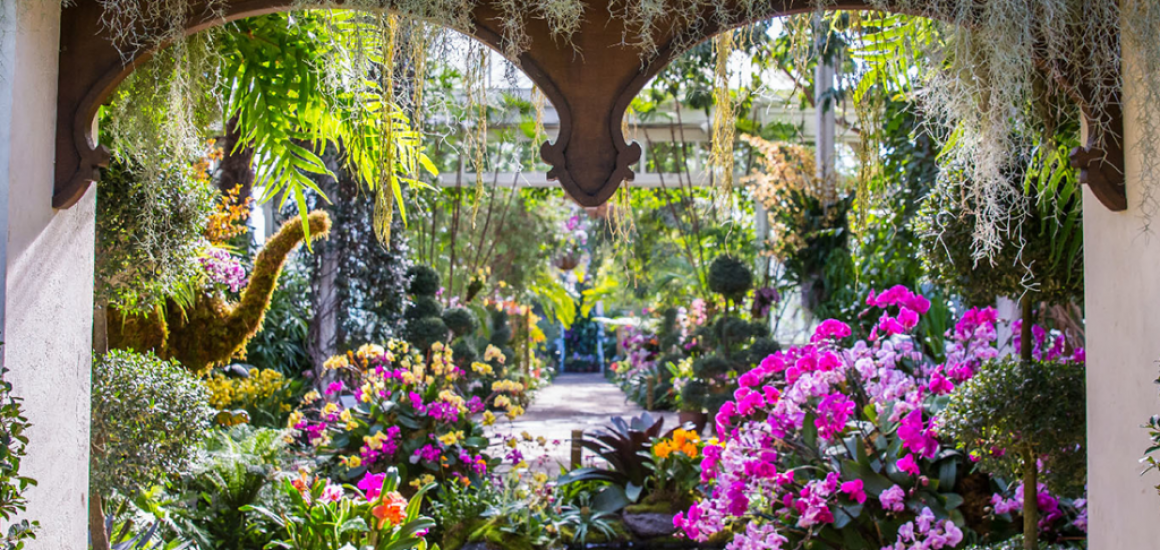
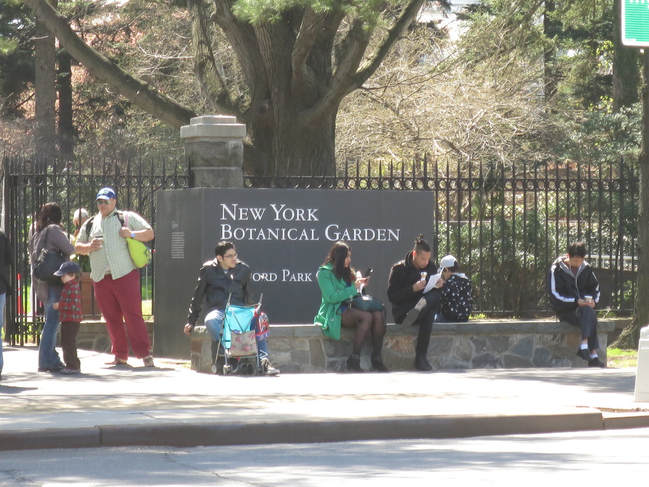
Located in The Bronx, The New York Botanical Gardens is host to the The Orchid Show each Spring. (c) travelincousins.com
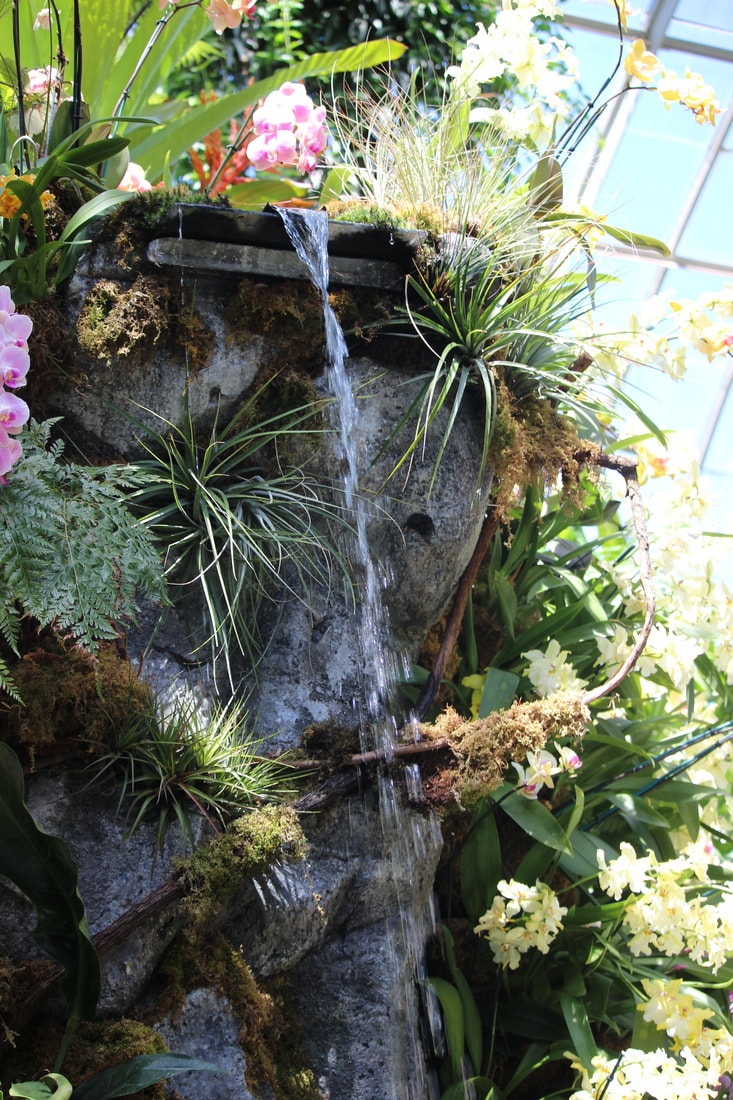
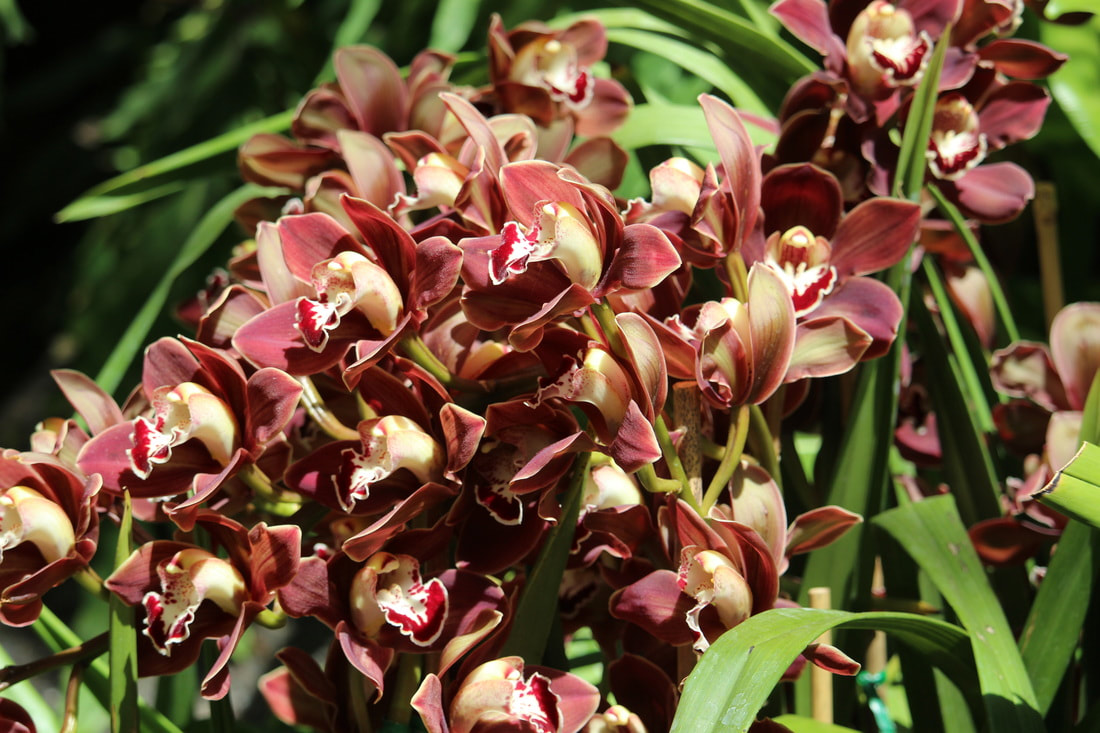
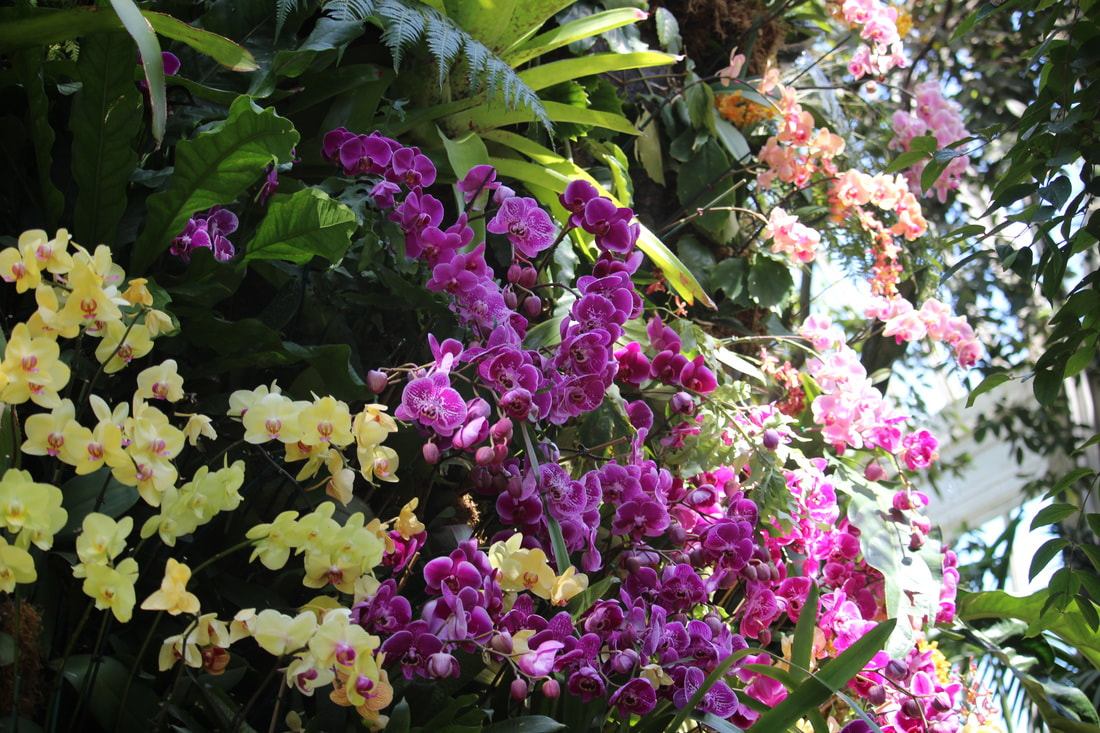
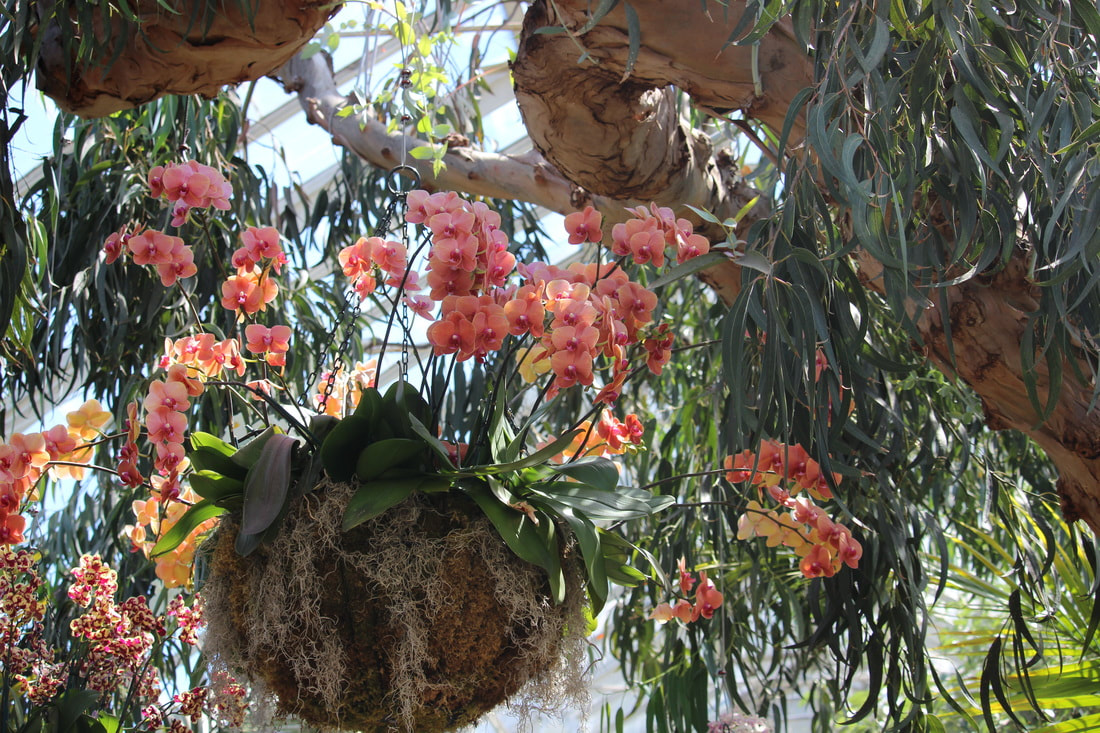
​Having traveled all over the world, and taken a tremendous number of photographs of flowers in every imaginable setting, I can say, wholeheartedly, that The Orchid Show at the New York Botanical Gardens ranks among the world's most lovely!

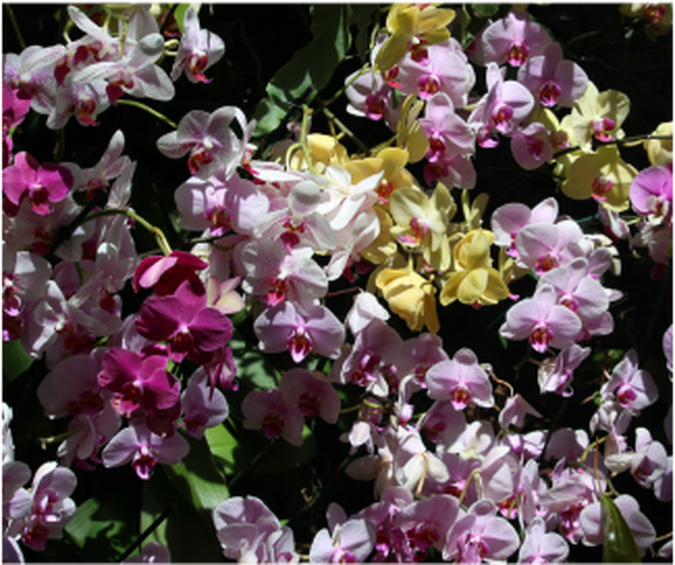
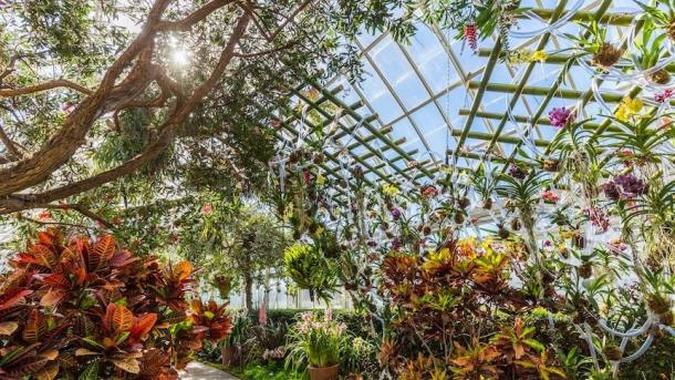
Each Spring, for the past sixteen years, The Orchid Show showcases thousands of dramatically displayed orchids in the Enid A. Haupt Conservatory. With tens of thousands of species thriving in habitats around the globe, orchids are some of the most diverse and well-adapted plants on Earth. There are an estimated 30,000 naturally occurring orchid species and tens of thousands of artificially created hybrids, making Orchidaceae the largest plant family on Earth!

While the show has ended for the 2018 season, the memories of Orchid Shows gone by are still indelibly ingrained in my memory!  My trip back in the Spring of 2016, to what was called, Orchidelirium, was a joyous day of sunshine, flowers and fun!
Picture
Just having parked near the Botanical Gardens in the Bronx (c)travelincousins.com
It was the final day of the Orchid Show, with the perfect blend of bright sunshine and mild temperatures, which, on its own, is enough on its own to  put me in a super mood.

​My girls and I drove into Queens, picked up our favorite exploration relative, Aunt Ro and then headed over the Triborough Bridge to The Bronx.  Although the Botanical Gardens opens at 10am and we arrived a bit after 11am, the parking on-site was already full! Not a problem on a gorgeous day, presenting us with an opportunity to take a morning stroll to the entrance of The Gardens.  It was obvious that many others were just as excited about the glorious day as well, because even the municipal parking lot, a block away, was jam packed with visitors and my little foursome ended up parking on the very top level!!


I'm really not sure if it was that Spring was in the air or because it was the last day of The Orchid Show, but boy did people come out in droves to spend a leisurely day in the beauty of nature.
Picture
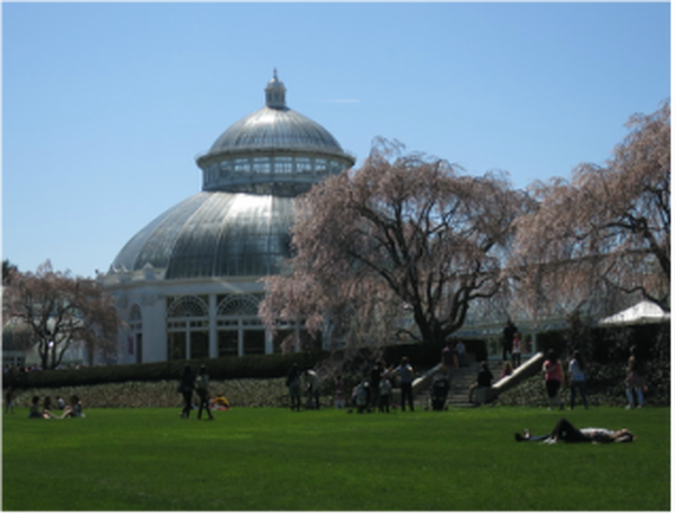
The Conservatory at the NY Botanical Gardens (c)travelincousins.com
Picture
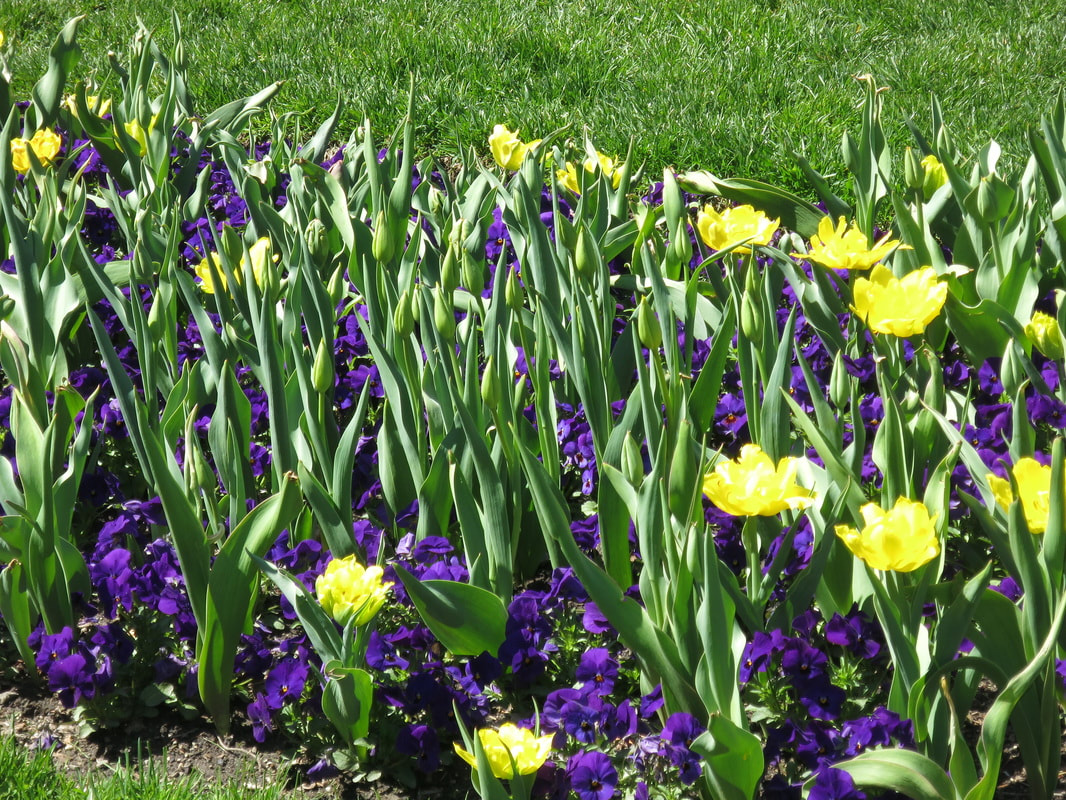
Flowers galore around the grounds of The New York Botanical Gardens, Bronx (c)travelincousins.com
Walking around the grounds of the Gardens was brilliant.  On this day, however, the real joy was inside the Conservatory, getting up close and personal with all those spectacular orchids!!

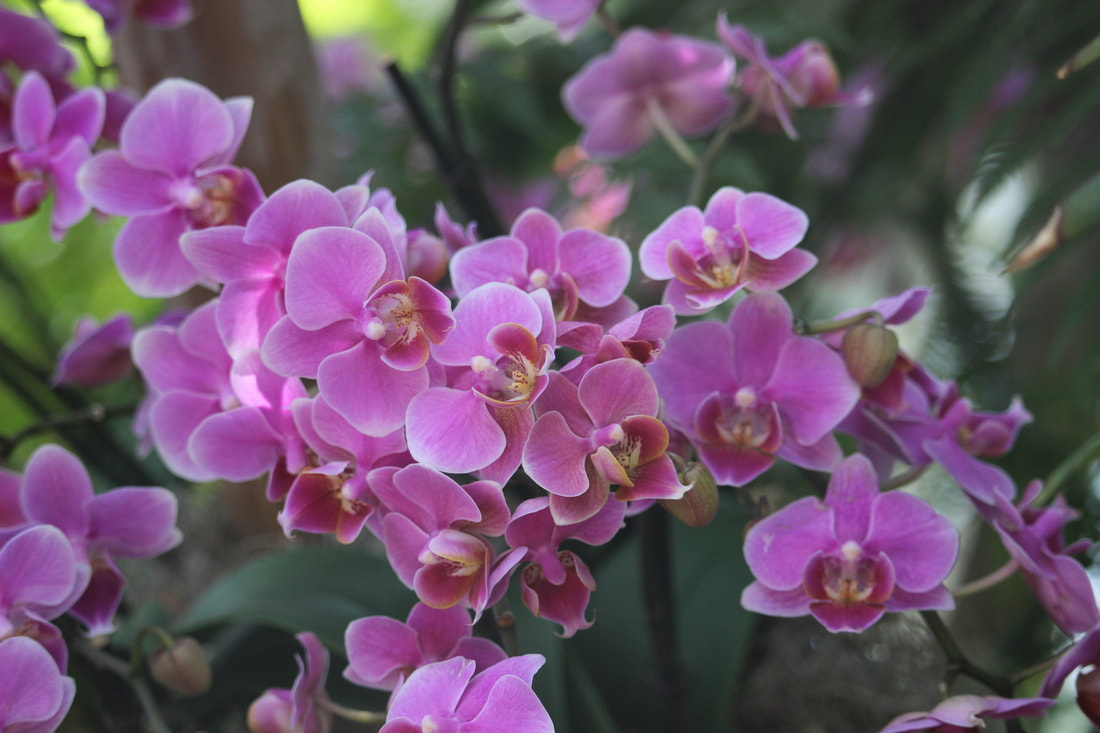
I could not stop snapping away!  Any flower lover will concur with me that it's virtually impossible to take too many pictures of these natural works of art! So many colors and shapes and sizes!

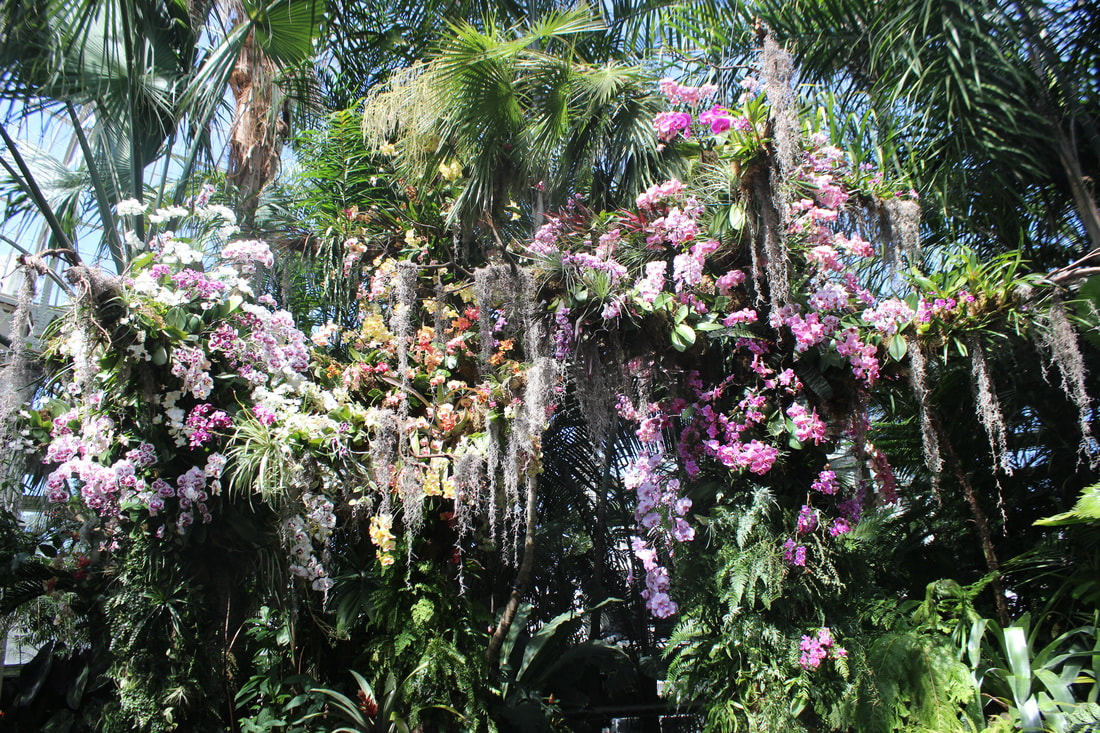
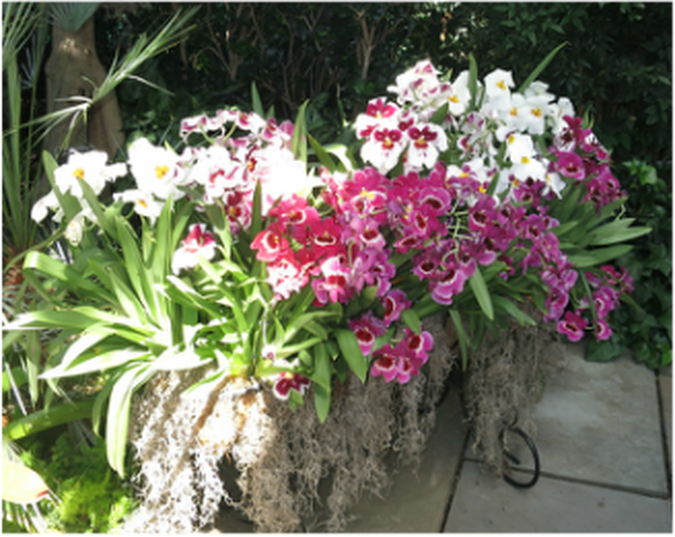
The array of displays throughout the exhibit was truly breathtaking as you can see!
Picture
Orchidelirium - 2016 Orchid Show at The New York Botanical Gardens (c) travelincousins.com
Picture
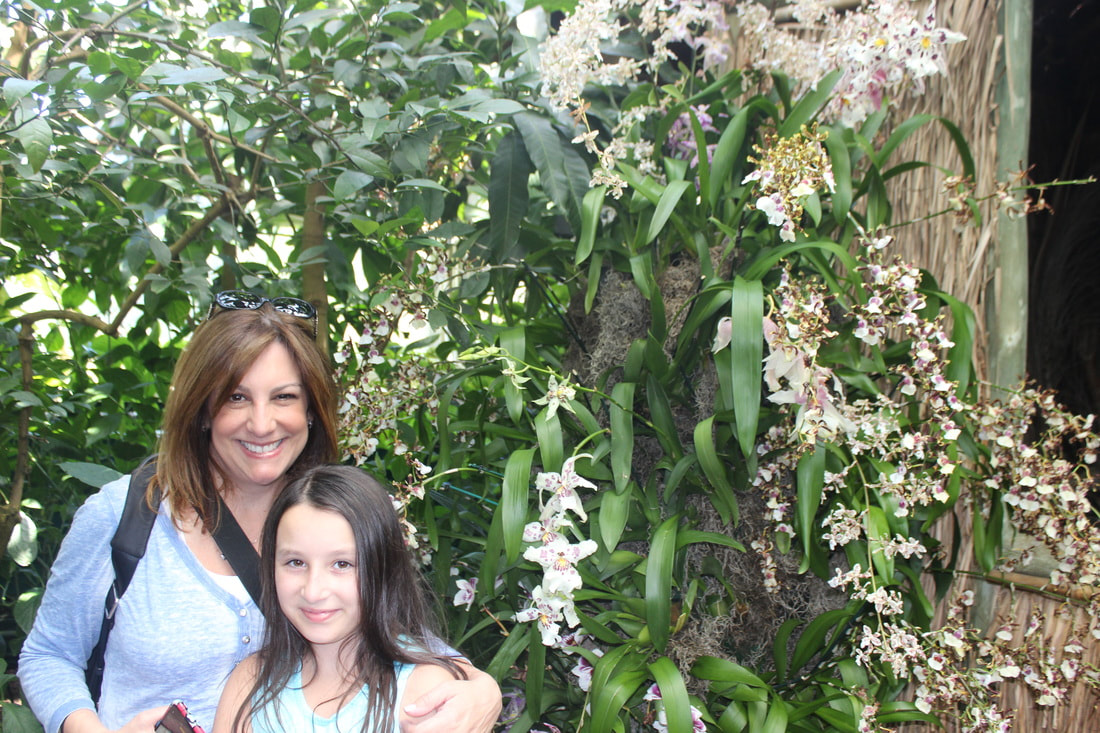
Me and Kelsey surrounded by orchids (c) travelincousins.com
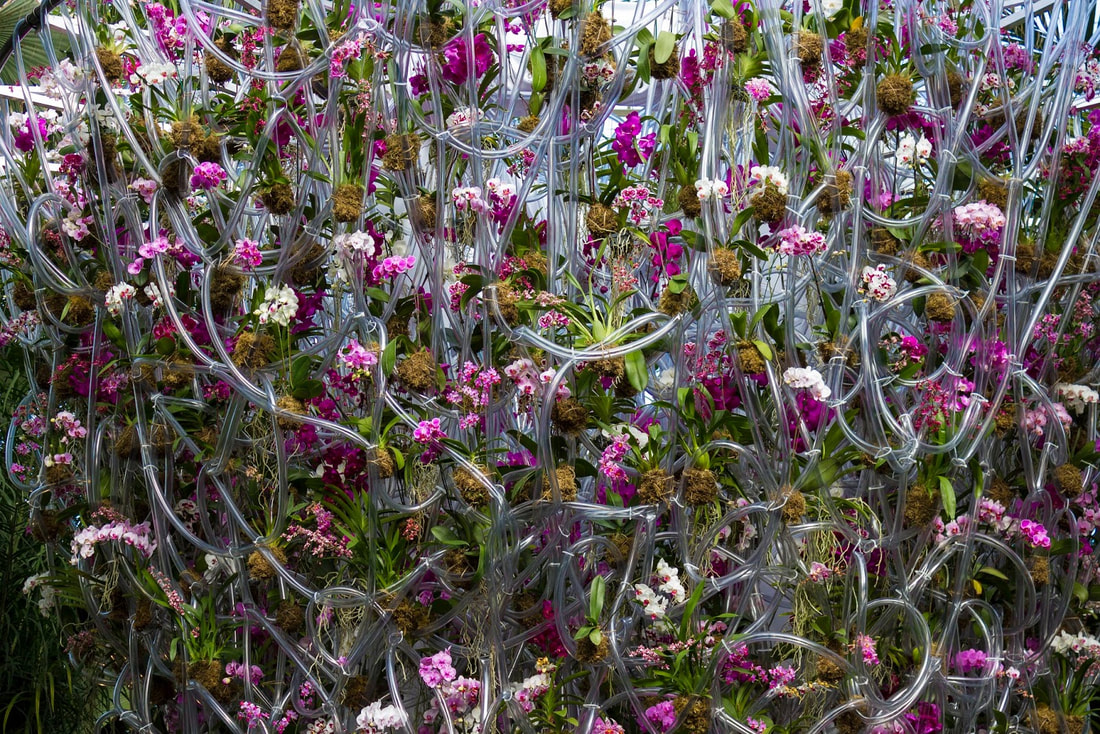
Marking its sixteenth year in 2018, The Orchid Show showcases thousands of dramatically displayed orchids in the Enid A. Haupt Conservatory featuring a series of installations crafted by Daniel Ost.

​Ost is celebrated worldwide for his eye-catching installations in private and public spaces, working with both living and cut flowers. His large-scale artwork has drawn comparison to that of renowned sculptors Anish Kapoor, Claes Oldenburg, and Andy Goldsworthy. In Belgium he has been called “the Picasso of flower arranging,” and in France he was touted as “the international star of floral decoration.”
Picture
Daniel Ost - creator of the floral installations at 2018 Orchid Show - In Belgium he has been called “the Picasso of flower arranging,” and in France he was touted as “the international star of floral decoration.” (photo credit: nybg.org)
In celebration of The Orchid Show's 16th Anniversary, here are
​16 Beautiful Facts About Orchids:
Picture
(c) travelincousins.com
​1. Orchids are one of the largest and most diverse groups of plants. Over 30,000 species of orchids have been described with researchers discovering hundreds of new species each year.
​
​
Picture
(c) travelincousins.com
2. In addition to those found in the wild, 100 000 varieties of orchids are created artificially, via selective breeding.
​
​
Picture
(c) travelincousins.com
​3. The lifespan of an orchid depends on the species but certain species can survive up to 100 years.

​
Picture
​4. Size, shape and texture of leaves depend on the habitat.

​
Picture
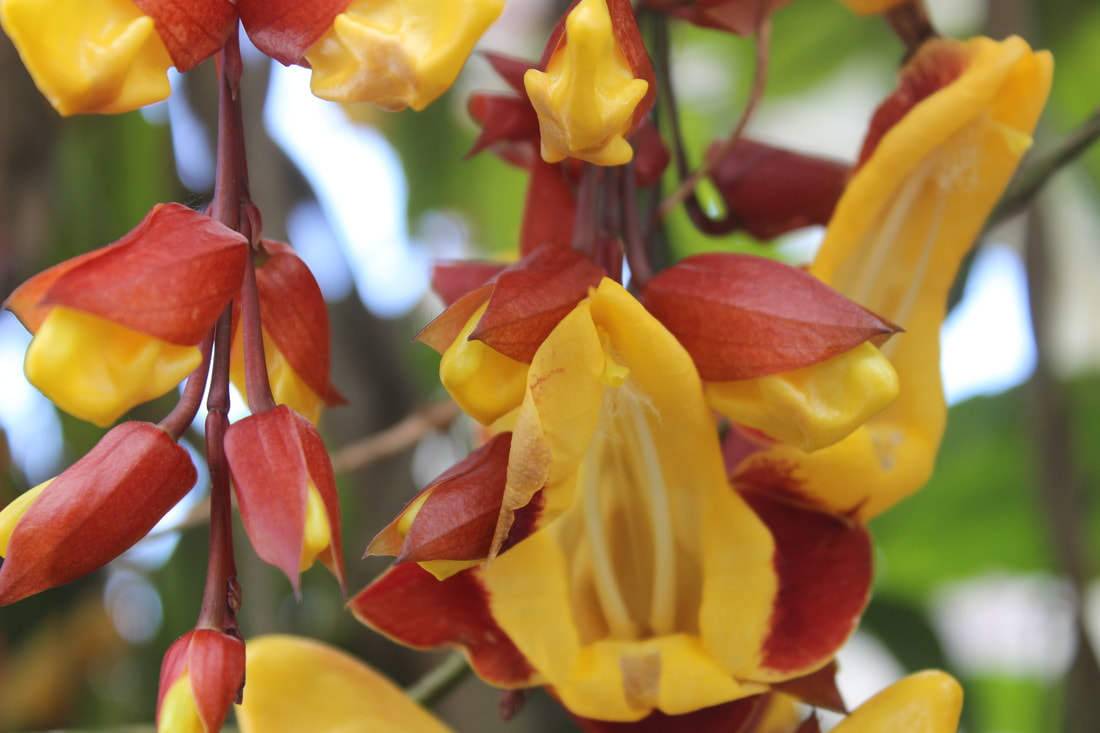
5. ​Orchids thrive in almost any environment around the world, from deserts to rain forests. 

​
Picture
(c) travelincousins.com
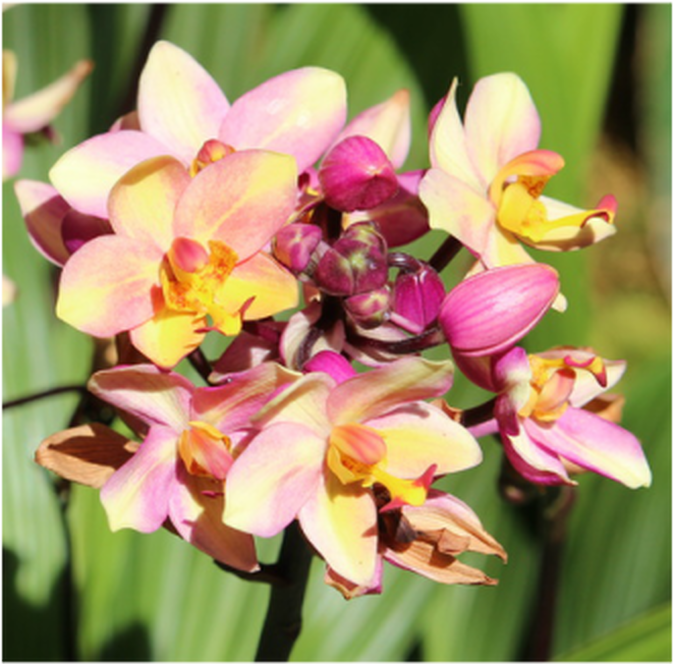
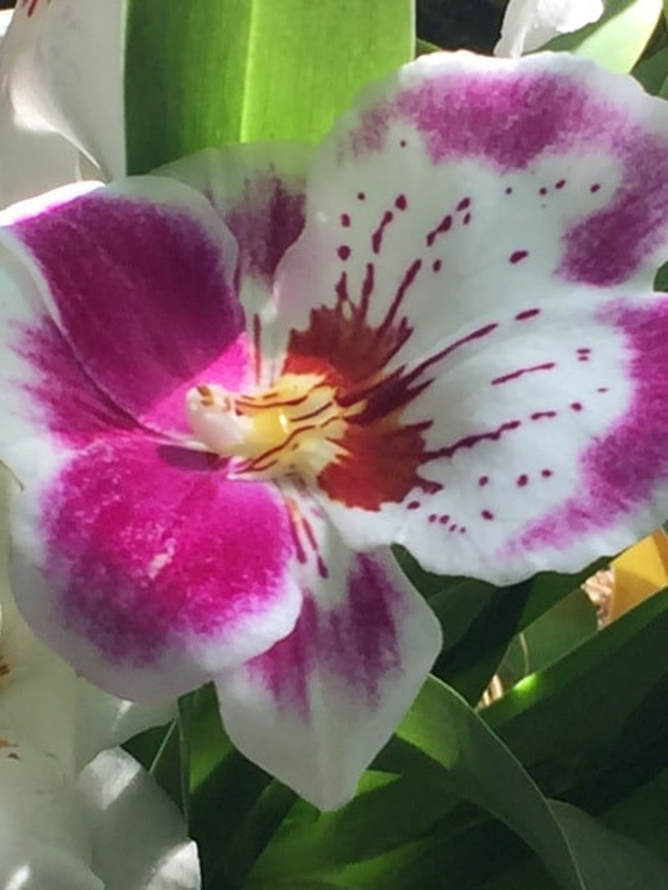
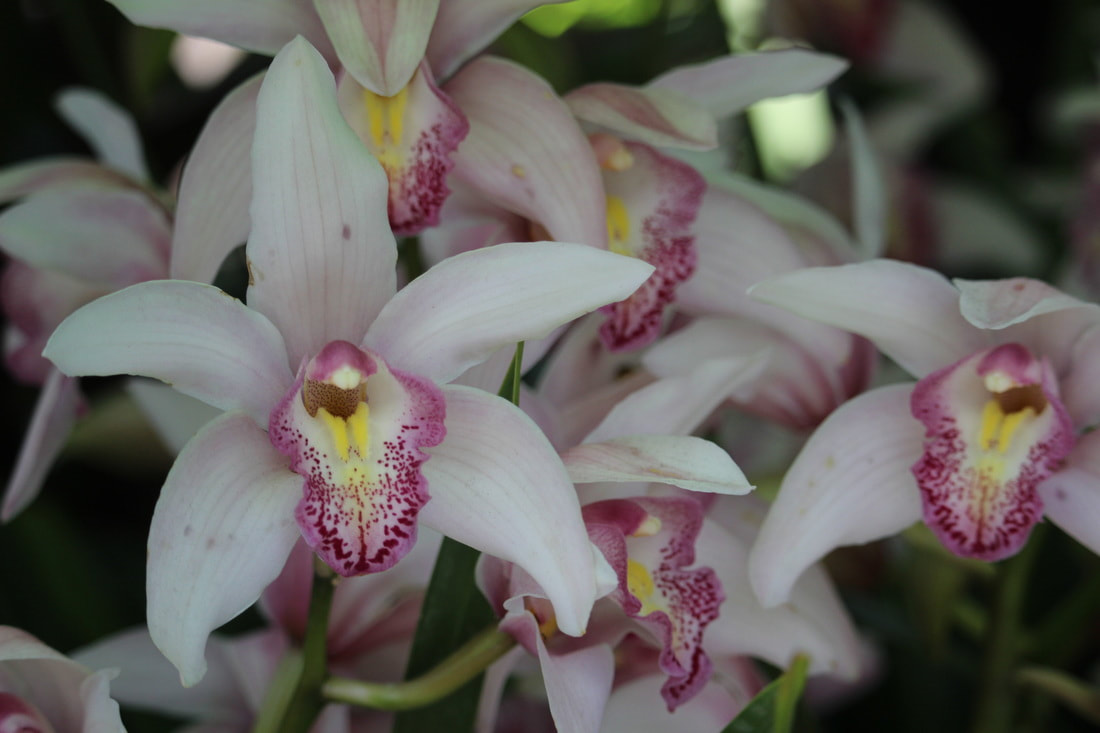
​6. Having evolved and adapted in order to survive and reproduce in such a wide variety of habitats, orchids grow in almost any size, color, and shape imaginable. 

​
Picture
(c) travelincousins.com
7. Substances derived from orchids are used spices, fragrance and in traditional Asian medicine.​

​
Picture
(c) travelincousins.com
8. Orchids produce several millions of miniature seeds. Only few seeds will develop into mature plant.

​
Picture
(c) travelincousins.com
9. In 1818 the naturalist William John Swainson sent back the first orchid specimen seen in London.

​
Picture
(c) travelincousins.com
10. According to the fossil evidence, orchids have existed on the planet for about 100 million years.

​
Picture
(c) travelincousins.com
11. ​​Orchid flowers always grow upside down when mature.

​

Picture
(c) travelincousins.com
12. An orchid has bilateral symmetry — like a human face — so if a line is drawn vertically down the middle of the flower, the two halves are mirror images of each other.


Picture
Crafted by Daniel Ost for the 2018 Orchid Show (photo credit: nybg.org)
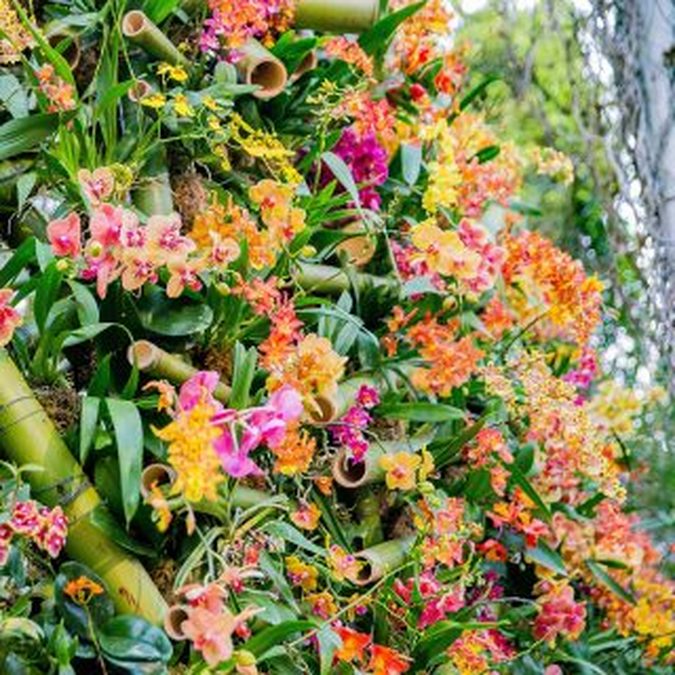
​13.  Orchids can be the purest white or almost solid black with every hue of the rainbow represented by an orchid flower. ​

​

Picture
2018 Orchid Show (photo credit: thereport.com)
14. Orchids grow on every continent except Antarctica.


Picture
2018 Orchid Show (photo credit: mariasorchids.com)
15. ​Orchids have the tiniest seeds in the world.

​
Picture
2018 Orchid Show (photo credit: metrous.com)
16.  A single orchid seedpod can contain up to 3 million seeds. 


-Elisa
0 Comments

April 16, 2018 - A Day At Mottley Kitchen in The Bronx with French Photographer Matteo Pellegrinuzzi

4/16/2018

1 Comment

 
FEATURED IN THISISTHEBRONX.INFO
​WEEKDAY MAGAZINE – A Day At Mottley Kitchen in The Bronx 
I made my way off the Bruckner Expressway/I-87 at the Willis Avenue exit in The Bronx, driving towards 140th Street, where I made an immediate right turn.  My GPS announced that I had reached my destination on the right hand side, within seconds of my turn.  I looked to my right, but all I saw were lovely, row houses; no cafe.  I assumed I must have zoomed right past Mottley Kitchen, which Alex Maruri, friend and business associate from Bronx Historical Tours, had so highly recommended for my meeting with French photographer, Matteo Pellegrinuzzi.
Picture
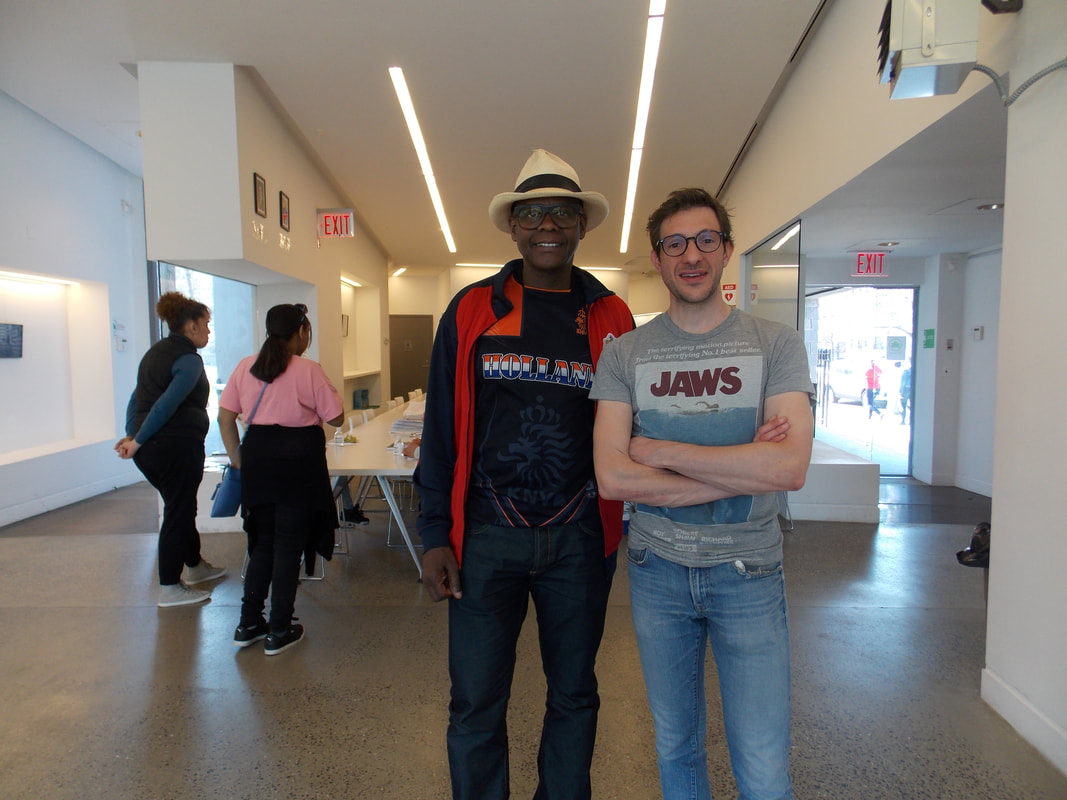
Matteo Pellegrinuzzi with me at Motley's Kitchen Cafe in The Bronx (c) travelincousins.com
As I continued driving up 140th Street, I spied a young lady getting out of a parking spot and immediately snatched it up. Living on Long Island for the past 20 years, I still remember how challenging it is to find a "good" spot in New York City, particularly The Bronx, from my college years at Fordham University.  

So proud of myself and the spot I found, I walked back in the direction from which I came by car (not noticing the alternate side of the street parking sign - but that's another story for later) and followed the numbers down till I was at number 402.  


The building had a tall wrought iron fence in front of it, but I didn't see a restaurant sign neither above on the building,  nor on the door.  Little did I know, was that there are two doors to this humble eatery and the one I did not enter through bore a sign with the name of the establishment.

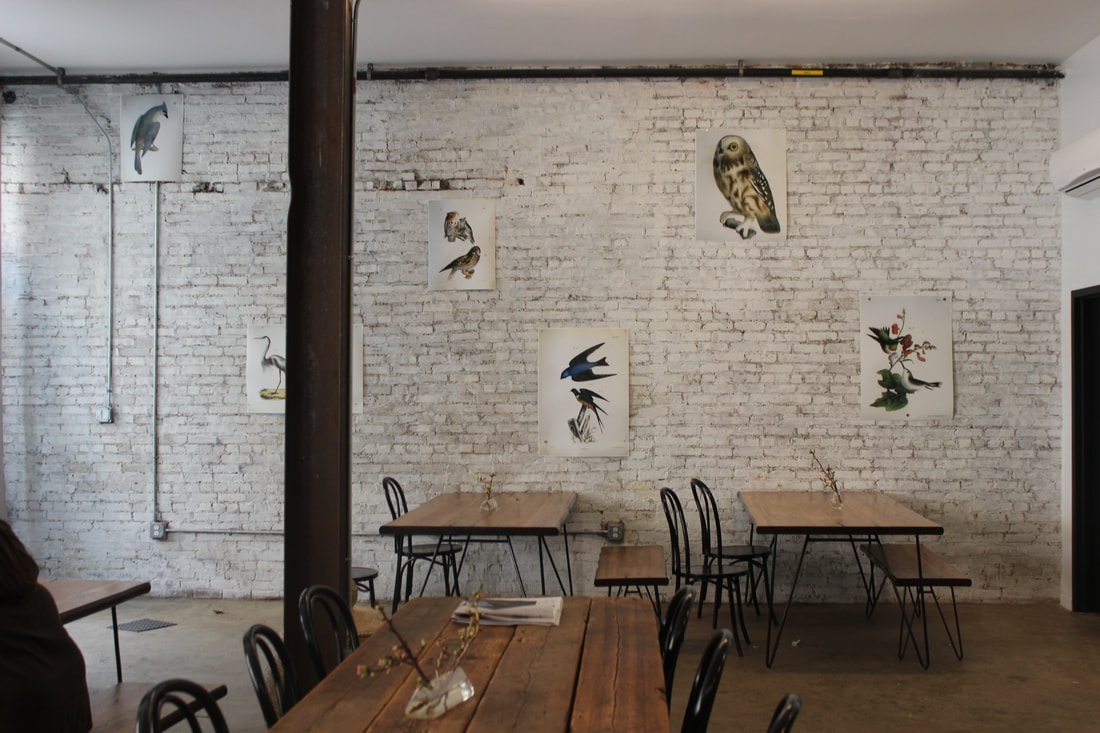
OMG! is what I said to myself as I entered.  What a great place!  Alex was pretty insistent about my coming to Mottley Kitchen, and at first view I understood why.  From the concrete floors throughout, to the rustic, white painted brick wall and steel beam columns, this cafe is part eclectic, part urban loft and definitely my kind of place! ​
Picture
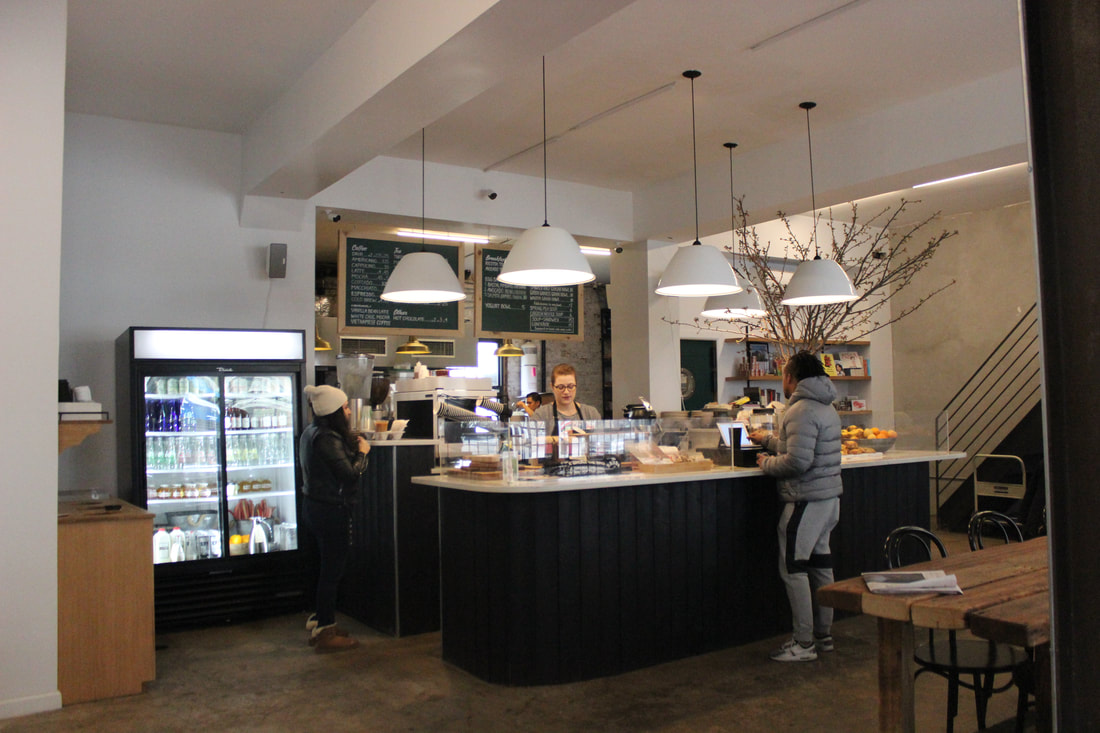
Mottley Kitchen in The Bronx (c) travelincousins.com
Picture
(c) travelincousins.com
Picture
(c) travelincousins.com
Picture
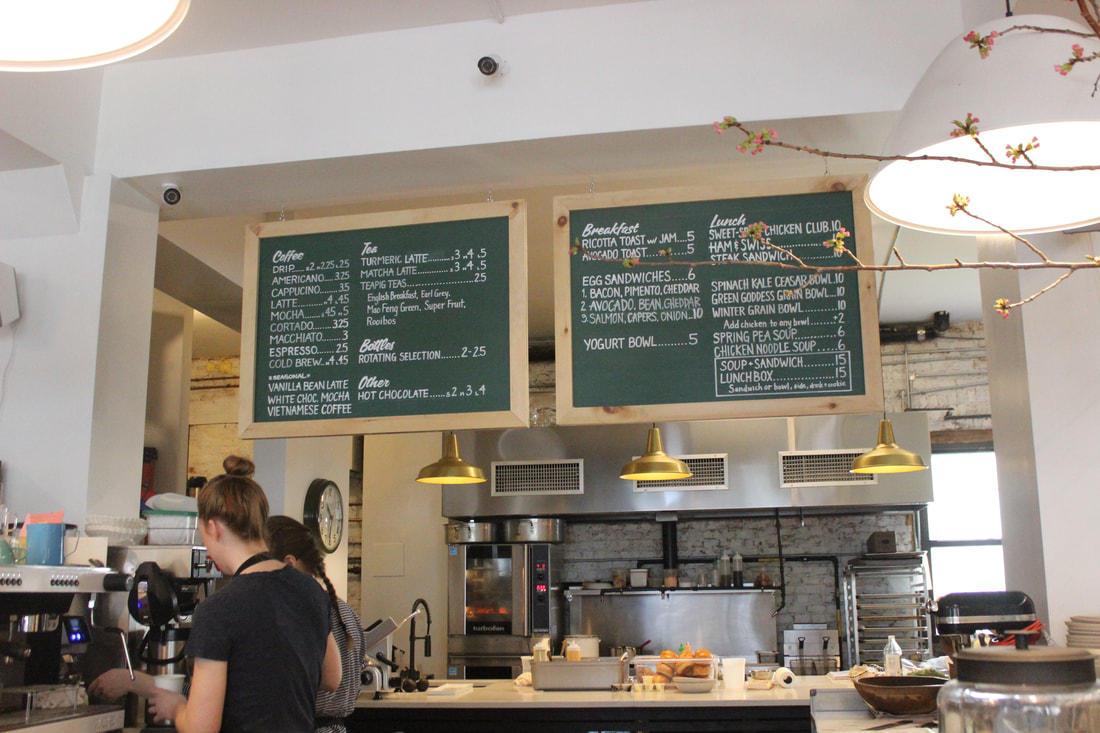
View of cook area (c) travelincousins.com
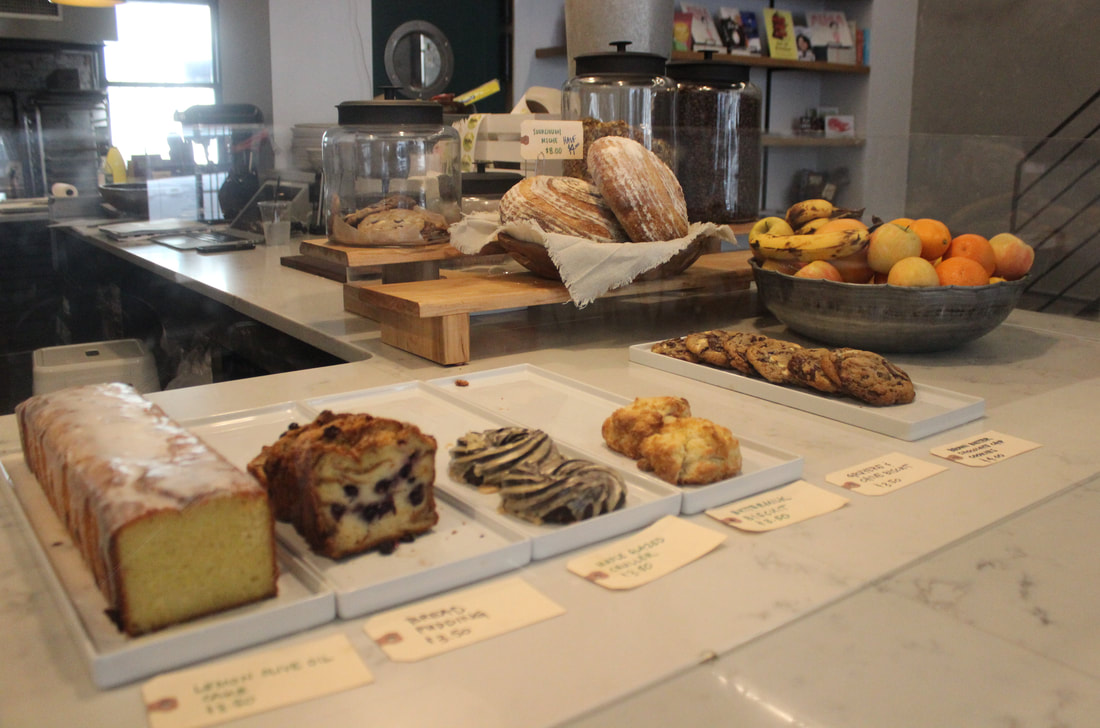
A large iron staircase lining one  of the walls, reveals the interior height of the relaxed, neighborhood bistro, while plain, unrefined rectangular wood tables fill the floor space, providing warmth and primitive appeal. Front and center lies the counter, sporadically filled with an assortment of fresh artisan breads and baked goods, while the working kitchen is in full view, set directly behind it, to reveal the cooks at work.

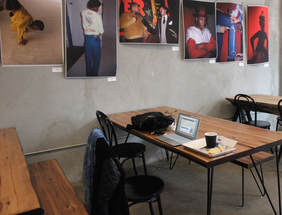
Arriving a bit early, I could not hold out for Matteo's arrival and resist the gruyere and chive biscuit that caught my eye, along with a rooibos tea.  After placing my order, I found a comfy table near the staircase and made myself at home with my laptop, camera and phone laid out, feeling like the other Bronx locals that were seated and those frequenting to take out their breakfast.
Picture
Yummy baked goods (c) travelincousins.com
Picture
My table (c) travelincousins.com
I recognized Matteo instantaneously from his website photos.  Casually dressed and seemingly, very at home in the middle of New York's northernmost borough, the two of us wasted no time chatting away, sharing our respective backgrounds and professional journeys.

Born and raised in Italy, Matteo departed his homeland for the city of Paris a decade ago, where he currently resides and is proud to call home.  His love of photography started at the tender age of four, taking his first photograph and soon thereafter, the proud owner of his very own camera at age six!  Matteo established himself as a professional photographer, first working for news agencies and then moving along to the glamour of fashion photography for such renown publications as Vogue Italy and G.Q. Magazines, respectively.

During our brief time together, it was clear that Matteo possessed the right balance in how he approaches his profession as a photographer and why his international success is off to a running start. His passion for creating photography collections that reflect his original visions and capturing them for the world to see, is equally matched with his savvy business sense in maintaining his ongoing success as an entrepreneurial "working photographer." Combining the rigors of his professional assignment work with the creation of his original, photography projects, he is able to expand and grow the latter by not falling into the trap of many creative types in becoming a "starving artist" who refuses to combine personal creativity with commercial endeavors.

The balance between these otherwise, seemingly opposed professional approaches has proven to be a good formula for Matteo as is evident from the success he has and continues to enjoy with his first major creative inspiration: "The Bronx-La Villette."
Picture
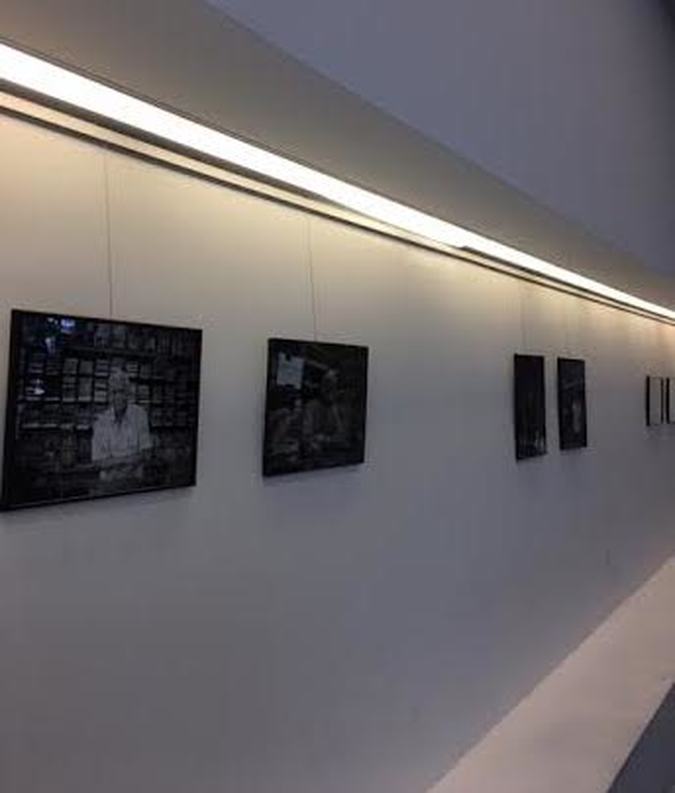
Part of The Bronx-La Villette Collection on Exhibit at Poe Park Visitor's Center, The Bronx, New York(c) matteo Pellegrinuzzi
The history of this project has its humble beginnings in a chance meeting through social media between Matteo and Alex Maruri.  As an admirer and follower of Matteo's work on Instagram, Alex began chatting with the photographer and would soon become Matteo's tour guide during his 2015 visit to New York, specifically, The Bronx.  

Through an extensive and detailed exploration of the many facets of this borough, Alex suggested that perhaps Matteo consider taking photos during his Bronx visit for a possible photography collection. Matteo took Alex's suggestion to heart and took many photos of the people he would meet and interact with during his walking tours with Alex through the South Bronx neighborhood.


Upon returning to Paris and getting caught up in the preoccupation of work and travel, Matteo finally focused on the images he had taken during his Bronx trip. Looking at his Bronx neighborhood photos with fresh eyes, after a number of months had passed, Matteo was intrigued by what he had captured in his simple portraits of the people who call The Bronx home, partaking in their ordinary, everyday lives.  He fancied the collection so much that he decided to embark on a similar endeavor, capturing the people of his own Paris neighborhood of La Villette, in their natural surroundings and daily lives, in much the same way.
Picture
Part of The Bronx-La Villette Collection on Exhibit at at Poe Park Visitor's Center, The Bronx, New York (c) matteo Pellegrinuzzi
Located east of Montmartre, in the 19th District of Paris, La Villette possessed some similarities to The South Bronx, more than three thousand miles away.  Interestingly enough, both of these neighborhoods, were situated slightly outside the city proper.  The Bronx is an outer borough of world renown Manhattan, the center of New York City.  Likewise, La Villette lies in the outer district of the epicenter of Paris.

These two areas, though technically, part of their main city, have more "neighborhood" qualities of family, hometown businesses and warmth, even though they are technically recognized as part of a bigger metropolis.

But perhaps, the greatest commonality is their dark and gray reputations to the world at large as "dangerous" and "unsafe" places. The Bronx has long endured the negative view from the outside as being a bad place, full of undesirables and peril to those who visit.  According to Matteo, he explained to me that La Villette suffered in much the same way, being portrayed on the world stage and in the media, as an unsafe area of Paris.


The globalized shadowy, somber and mirky reputations shared and promulgated in the news and by Hollywood has left a lasting impression in people's consciousness about these two neighborhoods.  However, Matteo's photography collection captures the humanity and down to earth aspects of the individuals that reside in The Bronx and La Villette, and call these neighborhoods home. 
Picture
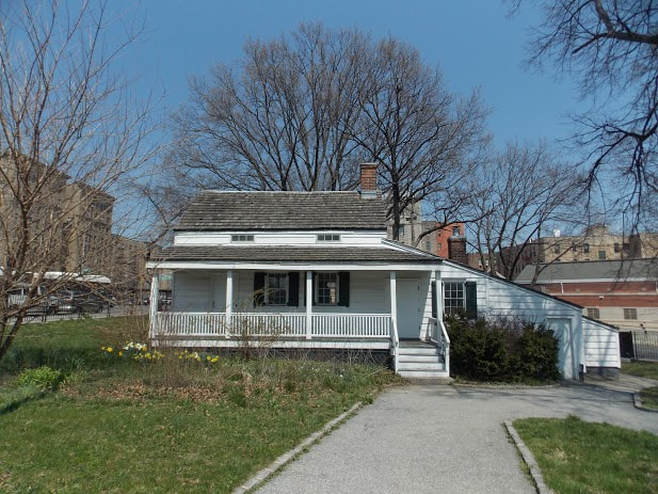
Poe Cottage , Poe Park, The Bronx, New York (c) bronxhistoricaltours
Picture
Matteo's photography lines the walls of the Poe Park Visitor's Center, The Bronx, New York(c) bronxhistoricaltours
Matteo returned to The Bronx in September 2017, for his first New York exhibit of "The Bronx-La Villette" at the Bronx Drafthouse. Once again, he is welcomed back to the borough, whose people he so beautifully captured in his photography, for a second exhibit this month through Saturday, April 28, 2018. This time "The Bronx-La Villette" is being showcased at The Poe Park Visitor's Center, across from Poe Cottage on the Grand Concourse.

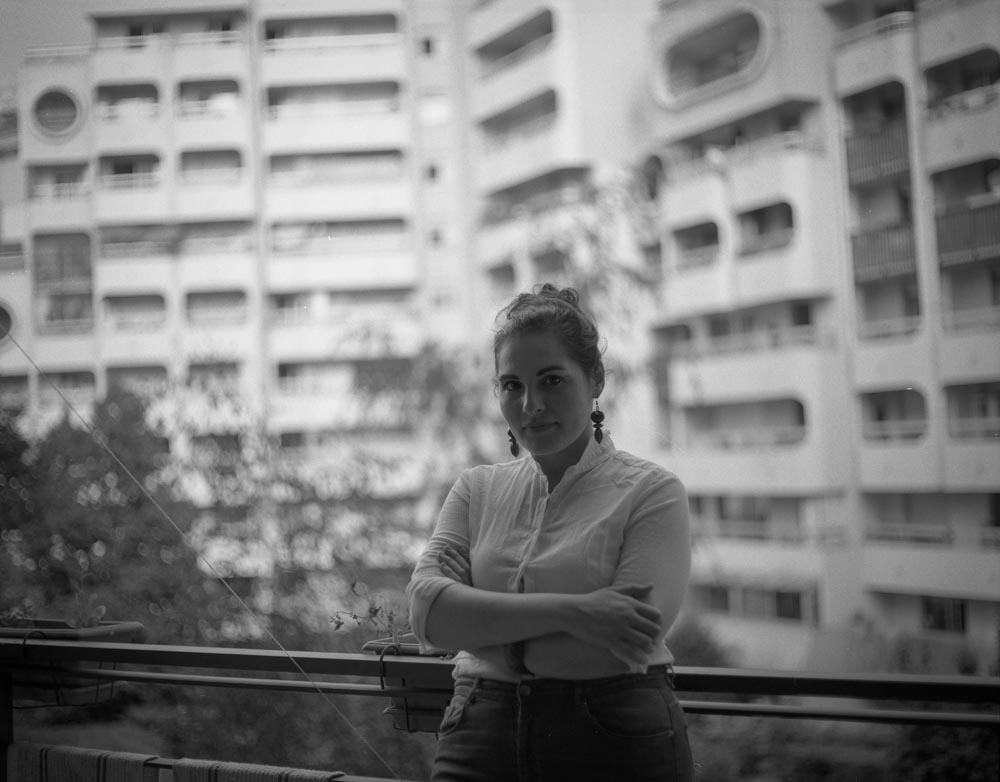
​Matteo and I spoke in detail about his style and photography preferences. He shared with me that, in his opinion, and quite obviously to the trained eyes of a photographer, good, old fashioned film is the best method for optimum photographic aesthetic quality. This is precisely how he shot his photos for The Bronx-La Villette project, all of which are featured in black and white.  
Picture
Samuel Brooks, President of the Mott Haven Historical Districts Association (left) with Matteo Pellegrinuzzi (right) at the 2018 exhibit of The Bronx-La Villette (c) bronxhistoricaltours
Picture
Matteo Pellegrinuzzi, Janet Jimenez, Site Manager for Bronx Terminal Market (center) and Samuel Brooks (right) at Poe Park Visitor's Center, The Bronx, New York (credit: bronxhistoricaltours)

​The Bronx - La Villette collection contains roughly 50 images in total. Matteo has also self published a stunning hardcover book featuring the full collection of photographs, aptly titled "The Bronx-La Villette," which will soon be available through his website.

In addition to seeing the collection up close and personal this month in The Bronx, you can also follow Matteo on social media, including Instagram, links for which are on his website at  www.matteopellegrinuzzi.com.

-Elisa
For Your Information
The Bronx-La Villette
Through April 28, 2018
​​
Poe Cottage Visitor Center in Poe Park 
2640 Grand Concourse
Bronx, New York
(718) 365-5516
www.nycgovparks.org 
1 Comment

April 9, 2018 - 18 Must-Visit Places for Jazz Lovers

4/10/2018

0 Comments

 
April is Jazz Appreciation Month ("JAM") and in celebration, I've listed 20 Must-See Places around the country for the Jazz Lover!  I've visited a few of these and not only are they "JAM" packed with history and fun facts about, what many consider   'America's classical music', but these joints are FUN!!

Check them out!!
Picture
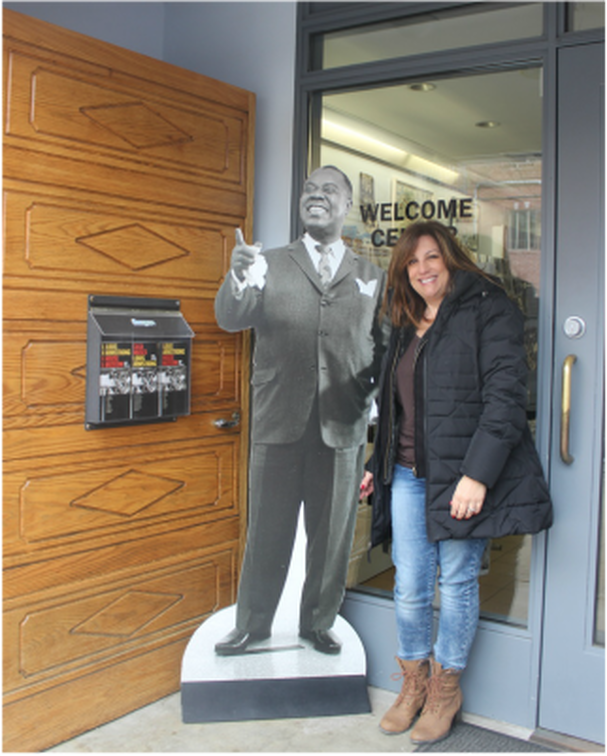
Outside the Louis Armstrong House Museum (c) travelincousins.com
1. Louis Armstrong House
Corona, Queens, New York

Louis Armstrong House

​
Located in the heart of Queens in Corona is the historical home of Louis Armstrong and his wife Lucille.  The American jazz icon lived here from 1943 to his death in 1971.  Now a museum and a National Historic Landmark since 1976, visitors will see the home, impeccably maintained, the way it looked when Louis and Lucille lived there!  Filled with memorabilia from Sachmo's career, as well as recordings of this great jazz musicians of all time, it's a definite must 

​
Picture
(credit: americanhistory.si.edu)
2. National Museum of American History
​Washington, D.C.

National Museum of American History

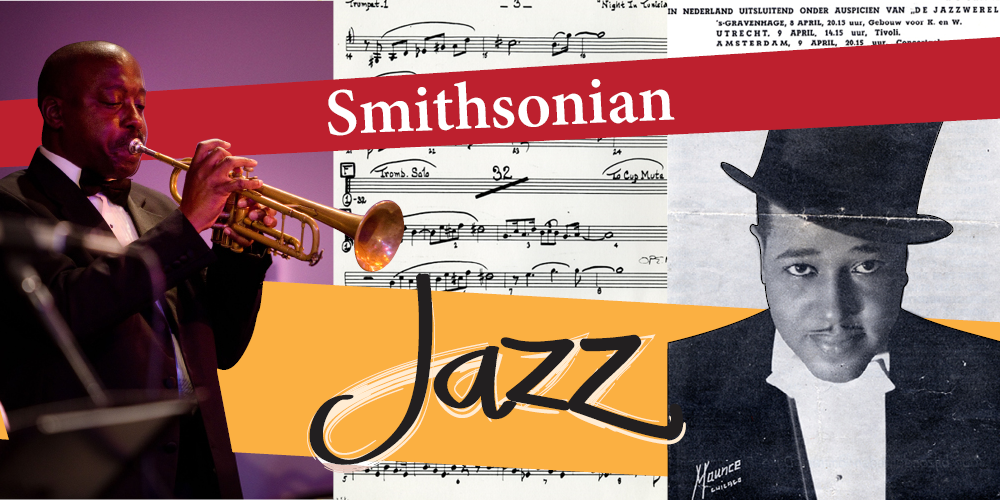
Smithsonian Jazz at the National Museum of American History explores and celebrates the American experience through the transformative power of jazz. If you are a jazz buff and interested in the rich heritage of this musical genre, you will enjoy the museum's extensive jazz collections and archives, the prestigious Smithsonian Jazz Masterworks Orchestra, exhibitions and educational programs found in our nation's capital.

​
Picture
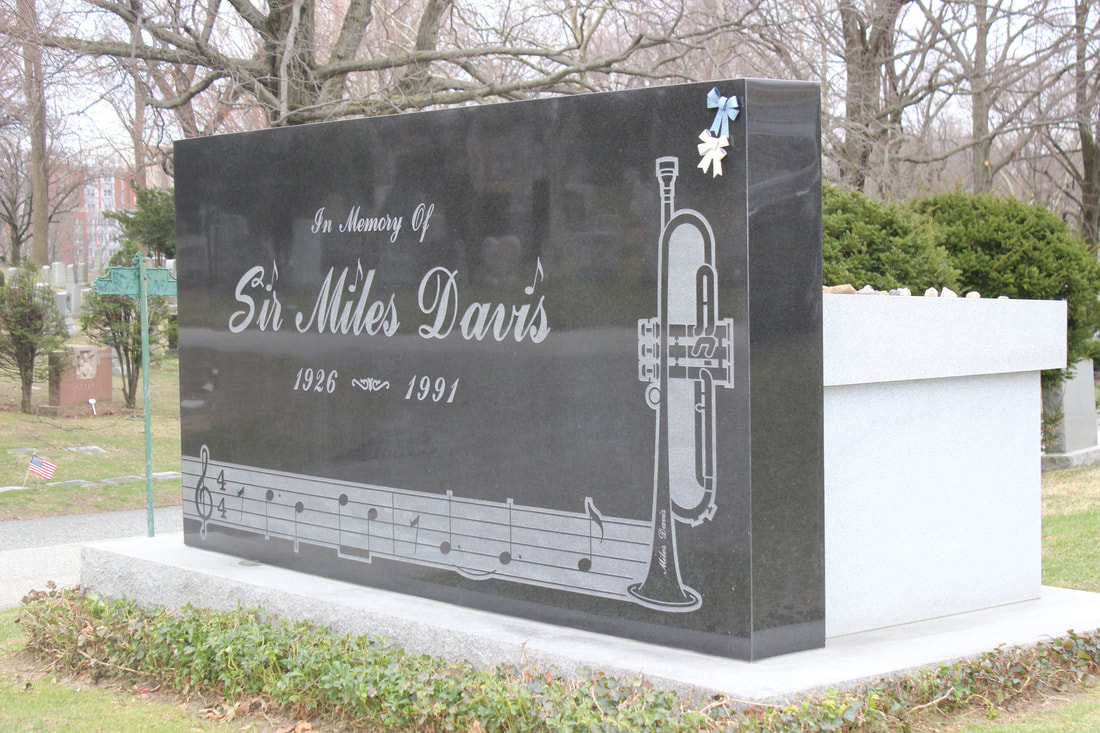
Jazz Corner at Woodawn Cemetery, The Bronx (c) travelincousins.com
3. Woodlawn Cemetery
The Bronx, New York
​www. thewoodlawncemetery.org


Woodlawn Cemetery is the final resting place for many famous and historical people - jazz is no exception.  In "​ Jazz Corner" are the gravesides of many musical greats including Sir Miles Davis, Duke Ellington, Illinois Jacquet, Lionel Hampton and more.

​
Picture
(credit: nps.gov)
​4. New Orleans Jazz National Historical Park
​New Orleans, LA
New Orleans Jazz National Historical Park


Created in 1994 to celebrate the origins and evolution of jazz, New Orleans Jazz National Historical Park is located in the Tremé neighborhood of New Orleans, near the French Quarter.  This U.S. National Historical Park's primary visitor center is located at 916 N. Peters Street and is a good starting point to learn about the history and culture of New Orleans jazz. Ranger-led demonstrations, talks, video documentaries and live music are held at both the visitor center and the New Orleans Jazz Museum performance stage five days a week.

​
Picture
The New Orleans Jazz Museum at the old US Mint (credit: neworleanspass.com)
​5. The New Orleans Jazz Museum
​New Orleans, LA

www.nolajazzmuseum.org

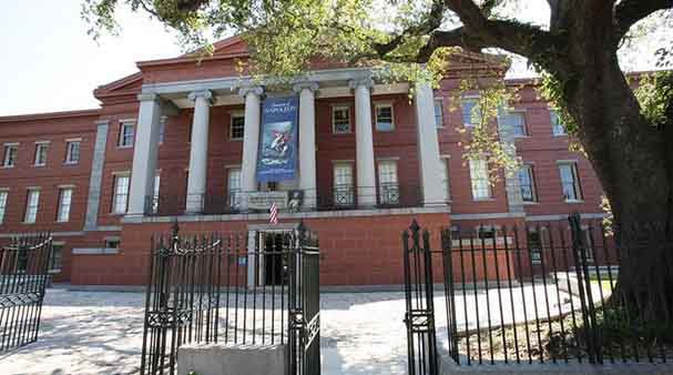
Housed in the historic Old U.S. Mint, and strategically located at the intersection of the French Quarter and the Frenchmen Street live music corridor, the New Orleans Jazz Museum is in the heart of the city’s vibrant music scene. Dynamic interactive exhibits, multigenerational educational programming, research facilities and engaging musical performances, the museum honors the music New Orleans made famous.


Picture
John Coltraine House in Philadelphia, PA (credit: johncoltranehouse.org)
6. ​The John Coltrane House
​Philadelphia, Pennsylvania
www.johncoltranehouse.org


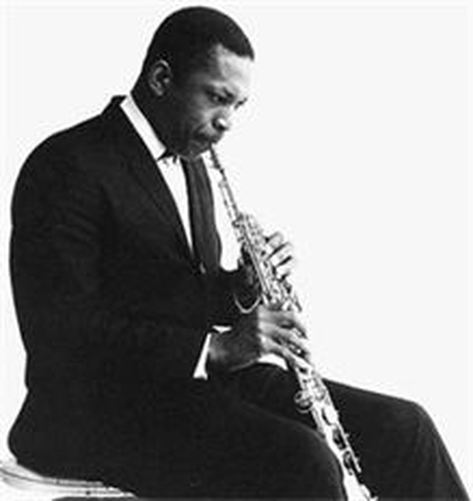
The John Coltrane House in Philadelphia is a National Historic Landmark. The former Philadelphia residence of John Coltrane as a publicly accessible historical site celebrating the life and music of this extraordinary musician, containing valued possessions and keepsakes from his career as a musician and from his childhood in North Carolina.  A definite visit for those who love this music virtuoso.


Picture
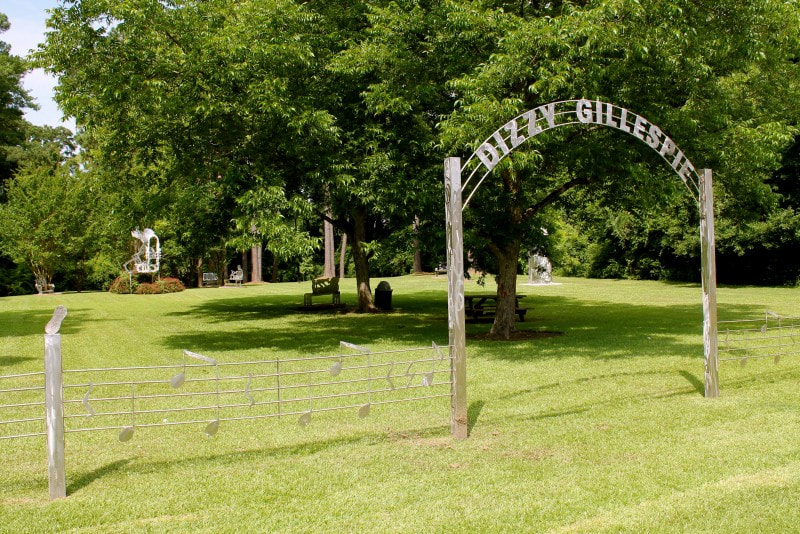
7. Dizzy Gillespie Homesite Park
​Cheraw, South Carolina
www.cheraw.com 


The town of Cheraw, South Carolina, is where trumpet great, Dizzy Gillespie grew up and in 2002, the town honored him with the dedication of this park on the site of his fame's home. Known to the world as "Dizzy", Gillespie was the youngest of nine children born on October 21, 1917, and from the first time he picked up a trumpet at age twelve, to playing with Cab Calloway at the age of 22, and to receiving a Kennedy Center Honors in 1999 for his outstanding lifetime achievement in the performing arts, this park is a tribute to this jazz great. Most notably in the park is the the stainless steel fence depicting the notes to "Salt Peanuts", one of Dizzy's best-known works.


Picture
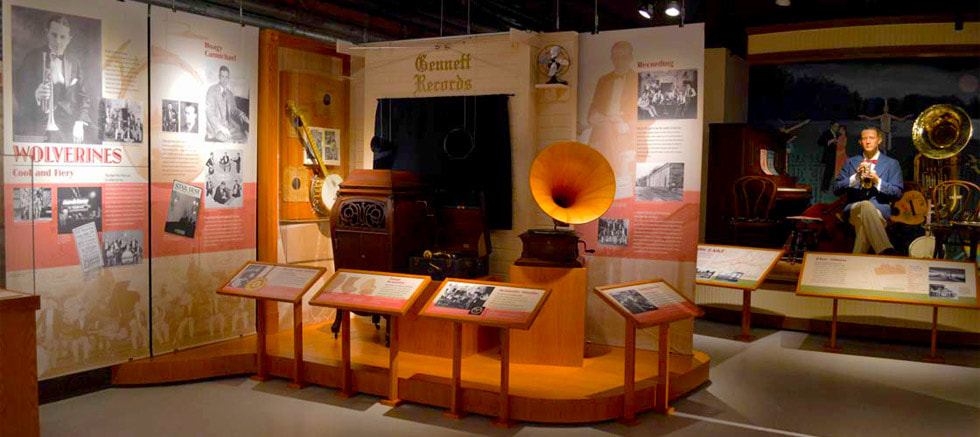
​8. Bix Beiderbecke House and the Bix Beiderbecke Museum & Archive
Davenport, Iowa
www.bixmuseum.org


​Since its grand opening in August 2017, the Bix Beiderbecke Museum in his hometown of Davenport, Iowa, honors the great American jazz cornetist and composer Bix Beiderbecke. Born in 1903 and departing the world in 1931, Leon Bismark "Bix" Beiderbecke made an amazing impact on the world of jazz music in his short thirty-one years as an American jazz cornetist, pianist, and composer. With Louis Armstrong and Muggsy Spanier, he is was one of the most influential jazz soloists of the 1920s.

Sights and sounds include unique artifacts, rare photos, storyboards, touchscreens, videos, home movie clips, heartwarming letters and, of course, magnificent recordings are on view at this museum.

​
Picture
(credit: 1976 Tom Marcello)
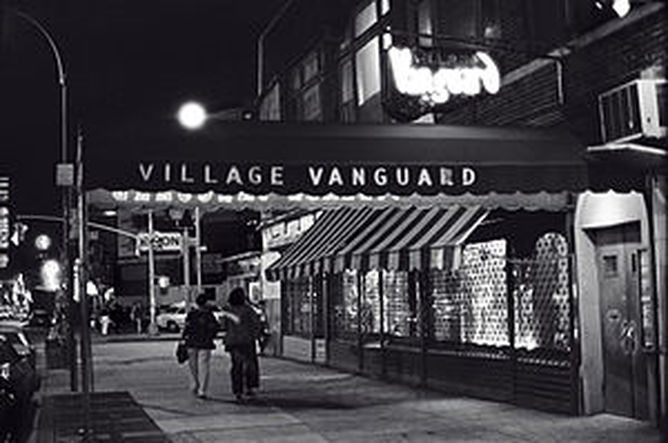
​9. Village Vanguard
Greenwich Village, New York
www.villagevanguard.com


Located at Seventh Avenue South in Greenwich Village, New York City, the club was opened on February 22, 1935, by Max Gordon. At first, it featured many forms of music, such as folk music and beat poetry, but it switched to an all-jazz format in 1957. Featured jazz greats booked at this club include Miles Davis, Horace Silver, Thelonious Monk, Gerry Mulligan, the Modern Jazz Quartet, Jimmy Giuffre, Anita O’Day, Charlie Mingus, Bill Evans (a regular), Stan Getz, Carmen McRae.  Today, it continues to feature jazz musicians.


Picture
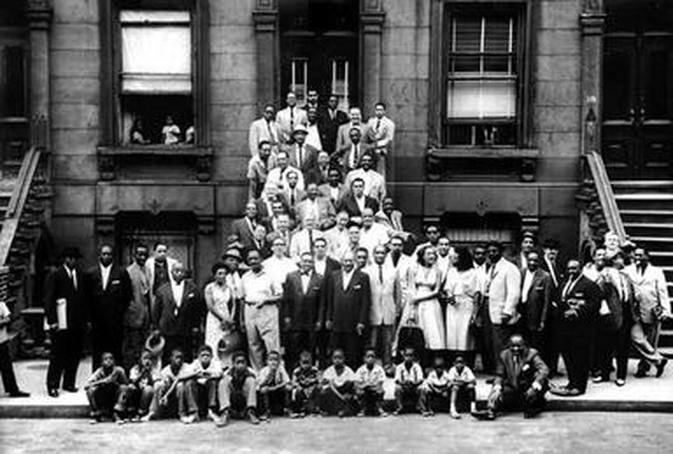
10. Harlem 1958  photo site – Art Kane’s historic portrait of 57 jazz icons, subject of the 1994 documentary A Great Day in Harlem
17 East 126th Street
New York, New York


​Imagine waling along East 126th Street, between Fifth and Madison Avenues in Harlem past #17, on August 12, 1958, only to see so many of America's jazz greats posed for a photo!  Well, that is precisely what occurred on this date, when Esquire Magazine freelance photographer, Art Kane, took this iconic photograph.  Too many to mention, the photo includes such talents as Dizzy Gillespie, Horace Silver, Sonny Greer, Buster Baily and Count Basie, tired of standing, so he sat down on the curb with the kids (far right).  

The site is still there, and a great place to see and imagine what it must have been like to be there on this historic day in jazz history!


Picture
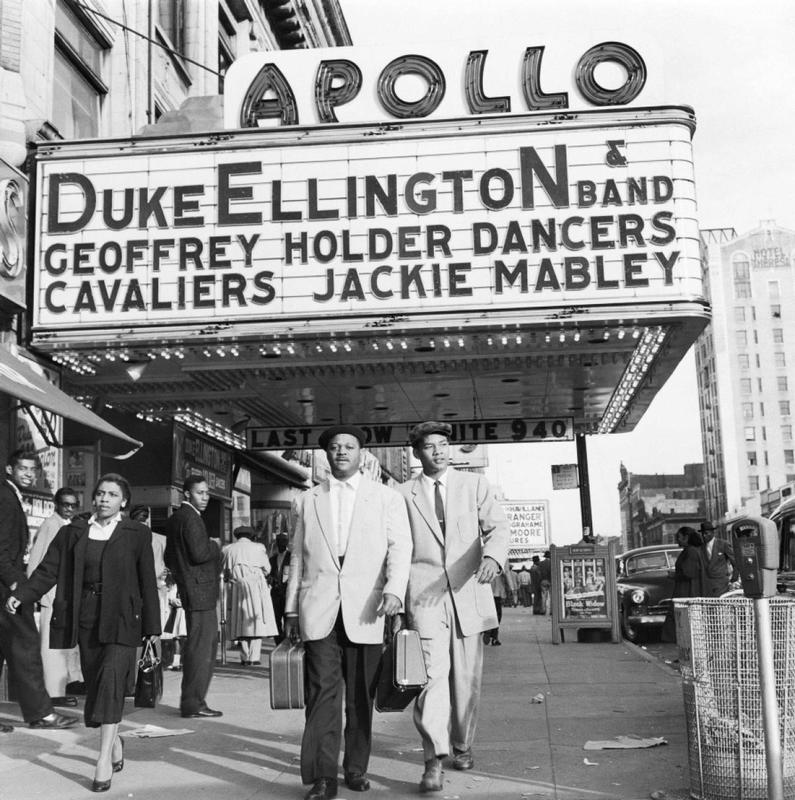
The Apollo Theatre is listed on the National Register of Historical Places and a New York City Landmark (credit: nydailynews.com)
11. Apollo Theater
New York, New York

www.apollotheater.org


Known the world over and featured in numerous Hollywood movies, The Apollo Theatre, which opened its doors in 1914, originally as a Burlesque Theatre. Through several owners, it was purchased in 1933, by Sidney Cohen, who owned other theaters in the area, and after lavish renovations it re-opened as the "Apollo Theater" on January 16, 1934,catering to the black community of Harlem. 

The Apollo Theater Legends Hall of Fame has inducted such renowned performers and music-industry figures as Aretha Franklin, James Brown, Michael Jackson, The Supremes, Stevie Wonder, Marvin Gaye, Elton John, Mymoena Davids, Little Richard, Hall & Oates, Ella Fitzgerald, Smokey Robinson, Billy Eckstine, Gladys Knight, The Pips, The Jacksons, Quincy Jones, Chaka Khan, Patti LaBelle, D'Angelo and Prince.  

Performers have included Billie Holiday, Pearl Bailey, Sammy Davis Jr., James Brown & The Famous Flames, King Curtis, Diana Ross & The Supremes, Parliament-Funkadelic, Wilson Pickett, The Miracles, Gladys Knight & the Pips, Rush Brown, Stephanie Mills, Dionne Warwick, Bobby Short, The Jackson 5, Patti Austin, Patti LaBelle, Marvin Gaye, Luther Vandross, Stevie Wonder, Aretha Franklin, Ben E. King, Mariah Carey, The Isley Brothers, Lauryn Hill, Sarah Vaughan, Jazmine Sullivan, Ne-Yo, and Machine Gun Kelly. Wow!!

It is listed on the U.S. National Register of Historic Places as well as being a NYC Landmark.

​
Picture
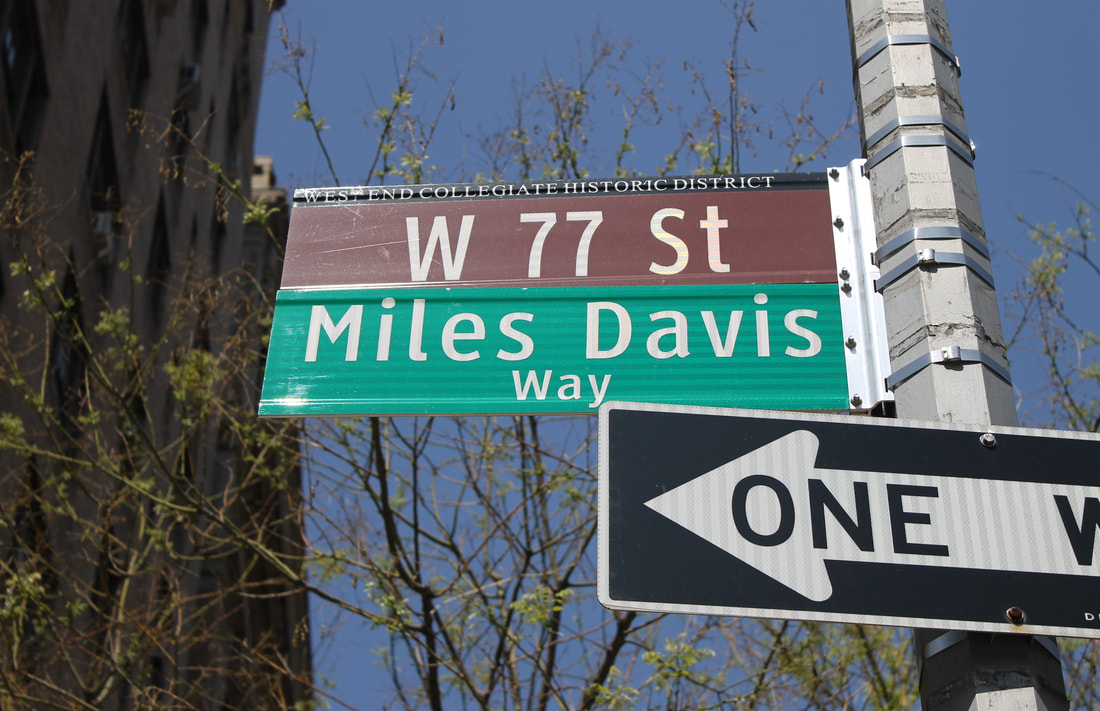
Renamed in honor of Miles Davis on May 26, 2014, which would have been his 88th Birthday (credit:wikipediacommons.org)
12. Miles Davis Way
77th Street, New York City


On May 26, 2014, 77th Street in New York City was rededicated and named 
77th Street “Miles Davis Way.” This day would have been Miles’ 88th birthday.  In a celebration that included a ceremony and complete street closure, the event was attended by hundreds of fans of the late trumpet icon as well as members of Davis’ family, who were on hand to host the event. Those included including son Erin, daughter Cheryl and nephew Vince Wilburn Jr., as well as actress Cicely Tyson (previously married to Miles).

Great photo op for those who loved the late great jazz legend.

​
Picture
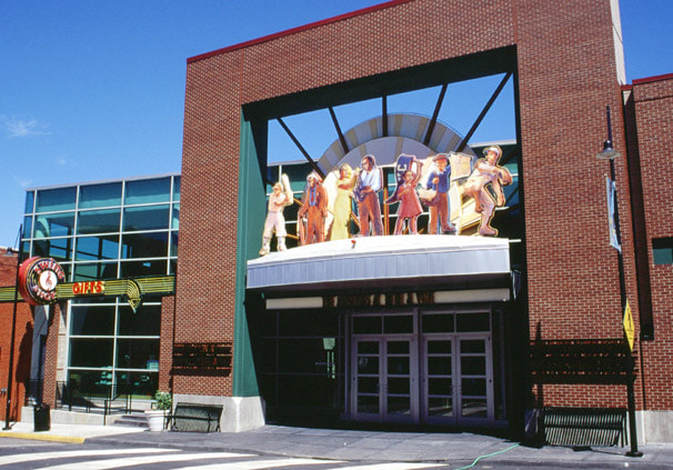
American Jazz Museum located in the historic 18th & Vine Jazz District in Kansas City, MO (credit: americanjazzmuseum.org)
13. American Jazz Museum 
Kansas City, Missouri

www.americanjazzmuseum.org

Located in the Historic 18th & Vine Jazz District in Kansas City, MO, the American Jazz Museum showcases the sights and sounds of jazz through interactive exhibits and films.  Since its inception in 1997, the Museum hosts thousands of students, scholars, musicians and fans of the arts for over 200 performances, education programs, special exhibitions, community events and more each year, providing an opportunity to learn about the legends, honor their legacy, or simply enjoy the sounds of modern day jazz.

​
Picture
(photo credit: pinterest.com)
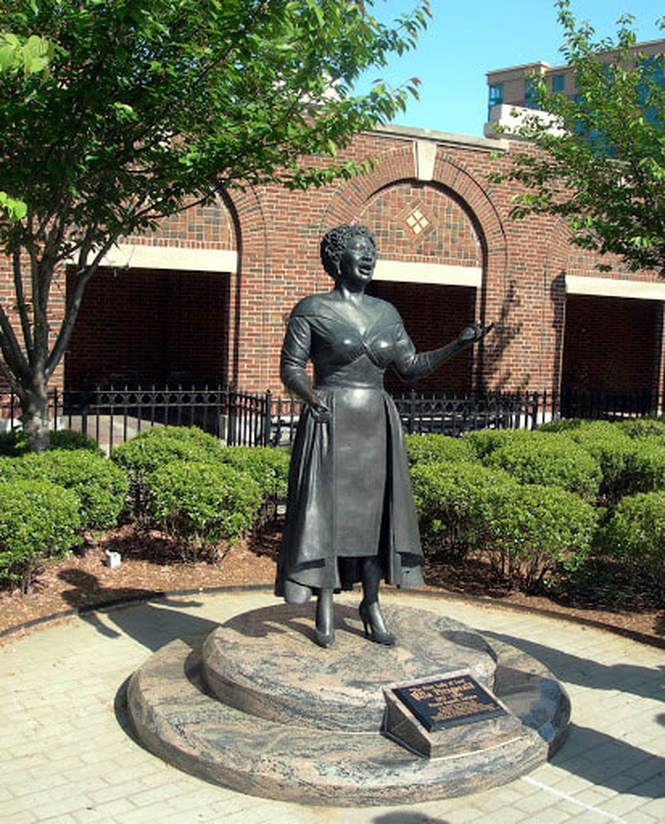
14. Ella Fitzgerald Monument
​Yonkers, New York


One of my all-time favorite singers - Ella Fitzgerald, is honored in Yonkers at the Metro North station.  There, she stands, a life-size bronze statue by Vinnie Bagwell, measuring 5 feet 10 and titled ''The First Lady of Jazz.''   The most celebrated jazz singer of her generation, the statue was placed on a two-tiered granite pedestal in Trolley Barn Plaza at the corner of Buena Vista Avenue and Main Street in October 1996.

Having grown up in Yonkers, Fitzgerald Fitzgerald lived near School Street and Park Hill Avenue and attended Public School 18 and Benjamin Franklin Junior High School.

​
Picture
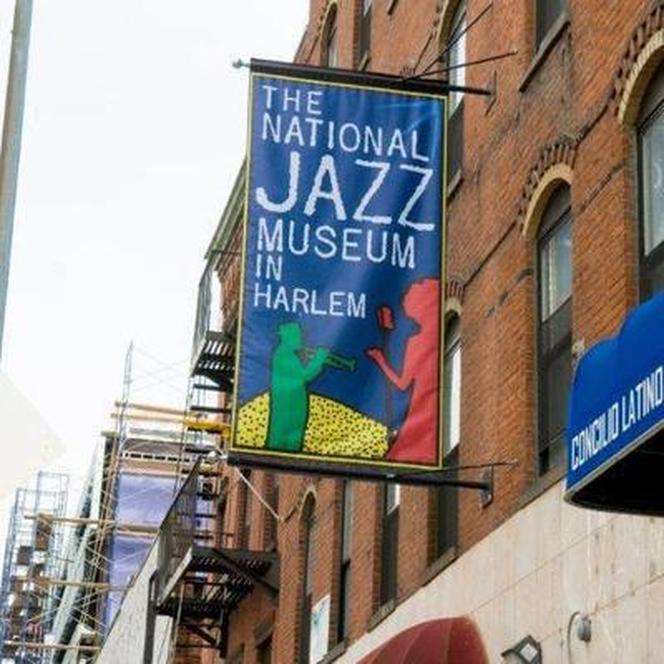
National Jazz Museum in Harlem (credit: twitter)
15. ​National Jazz Museum in Harlem
​New York, New York
www.jazzmuseuminharlem.org 


The National Jazz Museum in Harlem, a Smithsonian Affiliate, is New York City's museum dedicated to preservation and celebration of Harlem's jazz history.  The Museum was founded in 1997 by Leonard Garment, Counsel to two U.S. Presidents, and an accomplished jazz saxophonist, Abraham D. Sofaer, a former U.S. District Judge and matching funds from the Upper Manhattan Empowerment Zone. Hosting more than 80 free events and education programs annually, the Museum is committed to keeping jazz present and exciting in the lives of a broad range of audiences: young and old, novice and scholar, artist and patron, enthusiast and curious listener. 


Picture
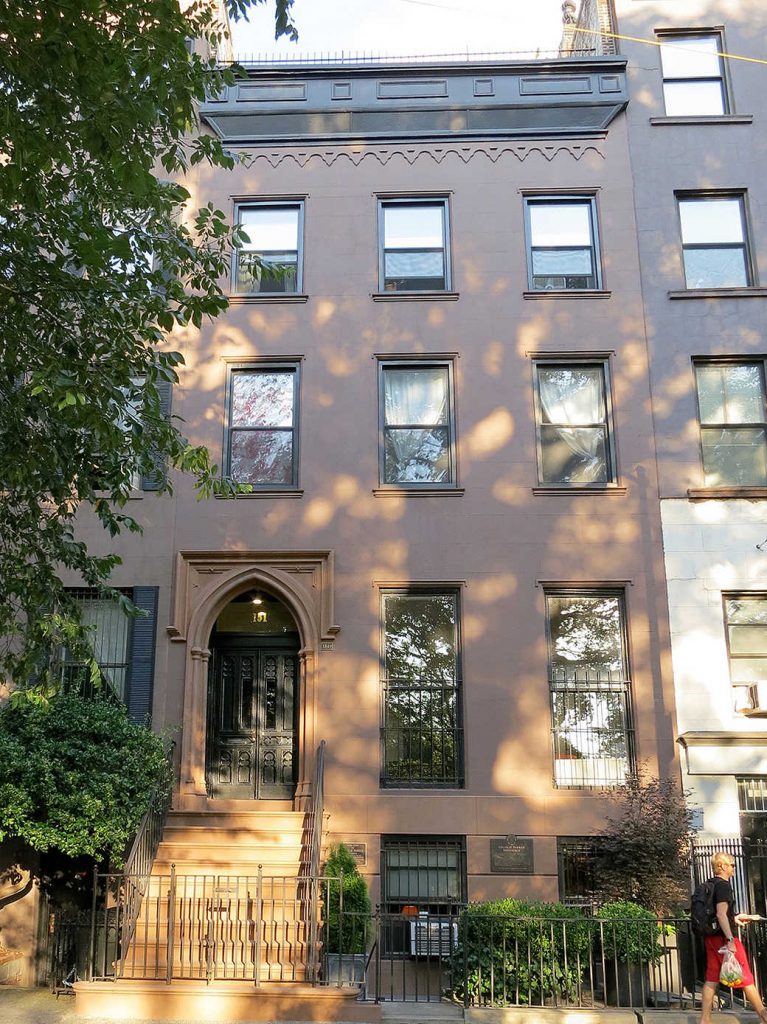
The Charlie Parker Residence (credit: charlieparkerresidence.net)
16. ​The Charlie Parker Residence
​New York, New York
www.charlieparkerresidence.net


Built in l849, this Gothic Revival-style rowhouse was home to the alto saxophonist Charlie Parker (Bird) from l950-l954. ​The Charlie Parker Residence was placed on the National Register of Historic Places in l994 by the U.S. Department of the Interior. In l999 the New York City Landmarks Preservation Commission designated the Charlie Parker Residence a New York City Landmark, finding the house at l5l Avenue B has special character, historical and aesthetic interest and value as part of the development, and heritage and cultural characteristics of New York City, New York State, and the nation.


Picture
(credit: wikipedia)
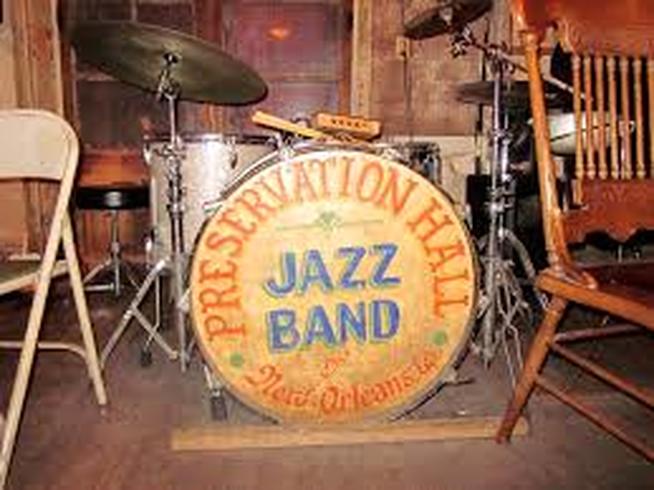
17. Preservation Hall
​New Orleans, Louisiana
www.preservationhall.com


New Orleans’ Preservation Hall was established in 1961 to honor one of America’s truest art forms – Traditional New Orleans Jazz. Operating as a music venue, a touring band, and a non-profit organization, Preservation Hall continues its mission today as a cornerstone of New Orleans music and culture.

Situated in the heart of the French Quarter on St. Peter Street, the Preservation Hall venue presents intimate, acoustic New Orleans Jazz concerts over 350 nights a year featuring ensembles from a current collective of 100+ local master practitioners. On any given night, audiences bear joyful witness to the evolution of this venerable and living tradition. Yet, another great jazz destination in the heart of NOLA.

​
Picture
(photo credit: Alamy)
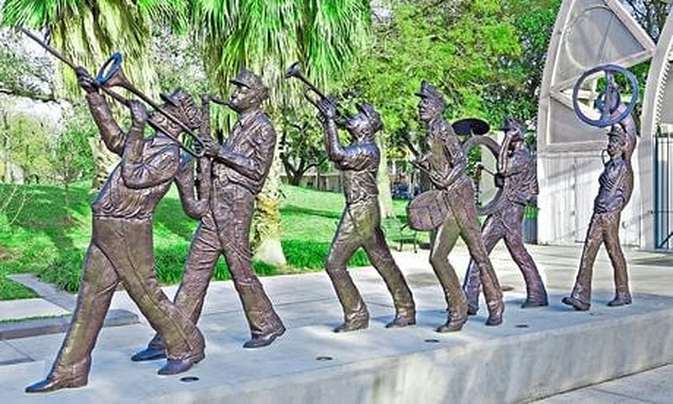
​18. Brass Band statue in New Orleans' Congo Square, the birthplace of jazz.
New Orleans, Louisiana
www.discoverhistoricamericatours.com 


In Louis Armstrong Park in Congo Square is one of the most iconic brass statues, worth seeing and snapping a few photos. Yet, another great jazz destination in the heart of NOLA!


-Elisa

​
0 Comments
    Picture

               Elisa 

     Elisa is co-founder of Travelin' Cousins travel blog along with her cousin "Travelin' Tanya." She lives on Long Island, New York with her two daughters and her dog Punkin. An entrepreneur whose professional career has included a variety of businesses in the toy, licensing and direct marketing businesses, she is now a blogger and freelance writer. Since her teen years, she has traveled extensively throughout the United States, Europe and Asia and continues to travel these days throughout the world with her daughters and cousin Tanya. Her other passions include photography, cooking, dining, the theatre and shopping.   

    Enter your email address:

    Delivered by FeedBurner

    Archives

    September 2020
    August 2020
    July 2020
    May 2019
    April 2019
    March 2019
    February 2019
    January 2019
    December 2018
    November 2018
    October 2018
    September 2018
    August 2018
    July 2018
    June 2018
    May 2018
    April 2018
    March 2018
    February 2018
    January 2018

    Categories

    All

    RSS Feed

The Scoop Blog
Travel Adventure Articles
Travelin' the NYC Outer Boroughs with Elisa
Walt Disney World Wednesdays
Travel Resource Guide
Vegan Dining Guide

                                                      
Fun Fact and Travel Trivia Articles
Elisa and Tanya's Favorites
Travel Tips - Know Before You Go
​
About
​Contact Us 
​Media Kit 
​
All of the photos on Travelin Cousins are taken by the Travelin’ Cousins Photographers unless otherwise noted. If you wish to use any content from Travelin Cousins please credit and link to the source or request permission by email.
(c) Travelin' Cousins 2020 -2024 All Rights Reserved