
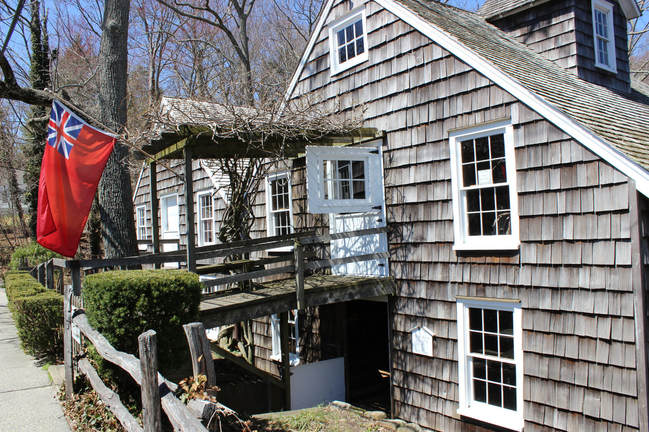
The Stony Brook Grist Mill (c) travelincousins.com
I am not going to lie, before I visited the Stony Brook Grist Mill, I really had no idea what it did or why it was so important.
After my visit and tour through the mill and around the grounds, from our exceptional tour guide, Richard, I feel rather enlightened and a whole heck of a lot more educated about grist mills and their necessity in centuries gone by.
Located in the Hamlet of Stony Brook, in the Town of Brookhaven, is Long Island's only working grist mill, which is listed on both the National and New York State Register of Historic Places. Planning a full day for me and my girls to investigate Stony Brook, the Grist Mill was one of the highlights of our itinerary.
After my visit and tour through the mill and around the grounds, from our exceptional tour guide, Richard, I feel rather enlightened and a whole heck of a lot more educated about grist mills and their necessity in centuries gone by.
Located in the Hamlet of Stony Brook, in the Town of Brookhaven, is Long Island's only working grist mill, which is listed on both the National and New York State Register of Historic Places. Planning a full day for me and my girls to investigate Stony Brook, the Grist Mill was one of the highlights of our itinerary.
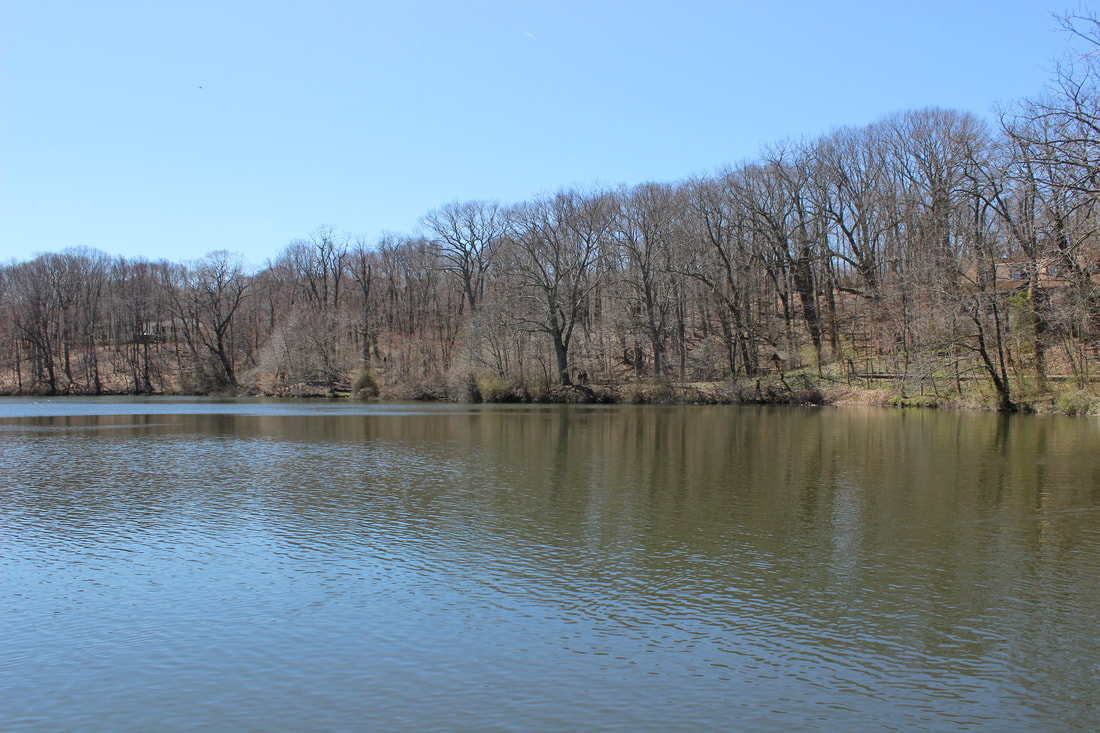
T. Bayles Minuse Mill Pond and Park in Stony Brook, across from the Stony Brook Grist Mill (c) travelincousins.com
The weather could not have cooperated more, on what was one of the nicest Spring days yet this year. Located off Main Street, the Grist Mill building is an unassuming, modest cedar shake edifice opposite T. Bayles Minuse Mill Pond and Park.
Just a gorgeous place to be on a sunny day, I strolled about the pond and the adjacent Avalon Park & Preserve, taking photos of this picturesque setting and its waterfowl and wildlife inhabitants that roamed about, awaiting for the opening of the Grist Mill.
No reservations were needed for the mill tour, and we were lucky enough to get a one-on-one private showing of this nearly 300 year old landmark. Our exceptionally knowledgable guide, Richard brought us back in time to the origins of the mill, the historic context in which it served the community and a perspective on life for the early settlers.
Just a gorgeous place to be on a sunny day, I strolled about the pond and the adjacent Avalon Park & Preserve, taking photos of this picturesque setting and its waterfowl and wildlife inhabitants that roamed about, awaiting for the opening of the Grist Mill.
No reservations were needed for the mill tour, and we were lucky enough to get a one-on-one private showing of this nearly 300 year old landmark. Our exceptionally knowledgable guide, Richard brought us back in time to the origins of the mill, the historic context in which it served the community and a perspective on life for the early settlers.
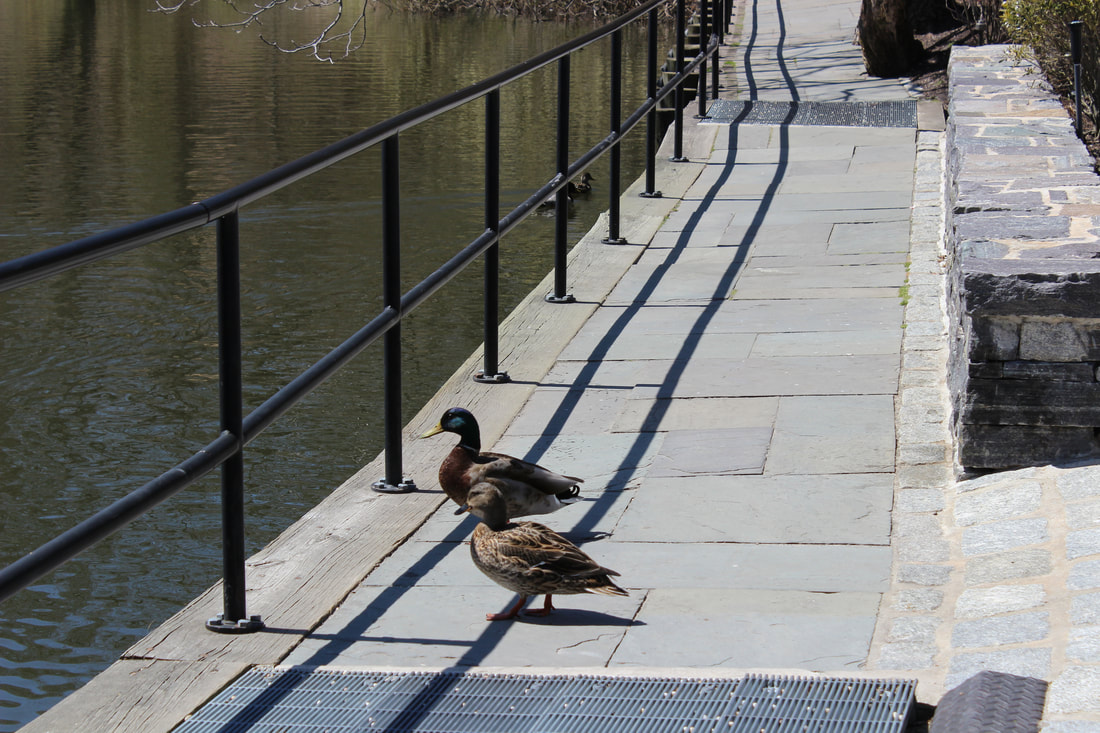
Some of the ducks I met walking along the pond (c) travelincousins.com
|
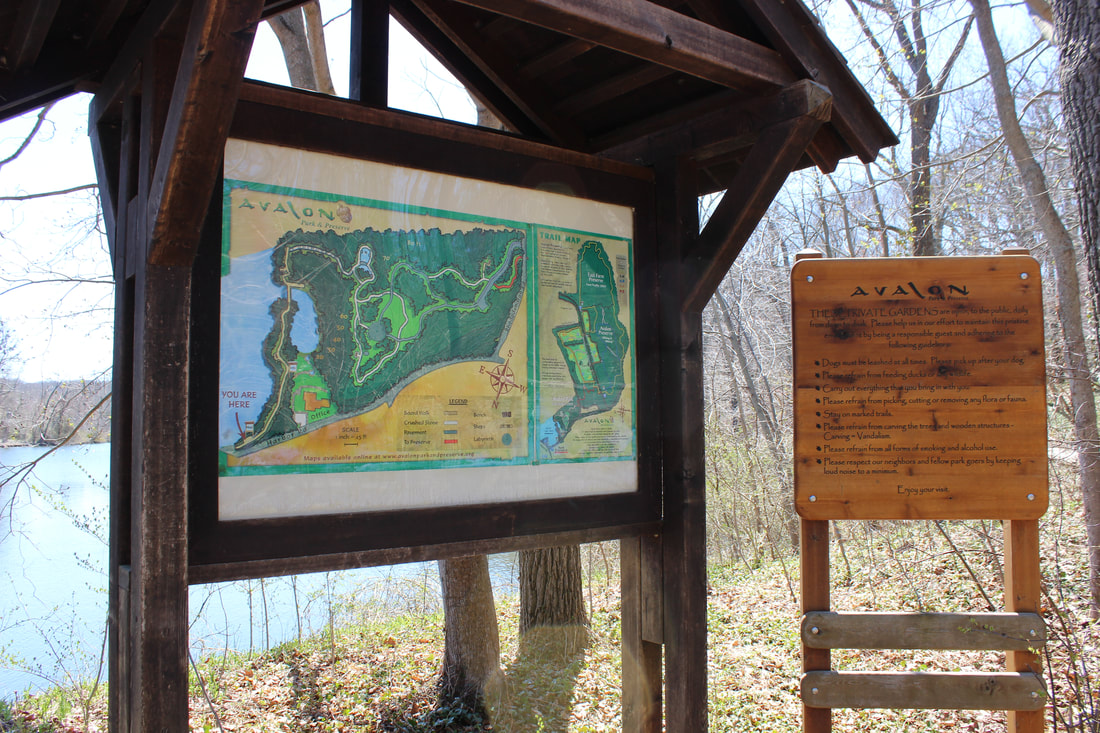
Entrance to Avalon Park & Preserve across from Grist Mill (c) travelincousins.com
|
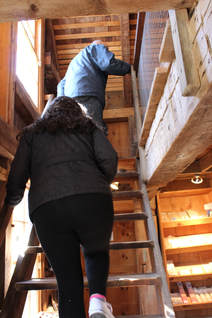 Gianna following Richard, our tour guide, up to the 3rd Floor of the Grist Mill (c) travelincousins.com
So what is so important about a grist mill? Well, in the early days of the settling of our country, we need to remember that there did not exist the same conveniences that we enjoy today. As Richard, our tour guide put it, "you couldn't just run down to Starbucks to get a croissant."
People grew their food, harvesting and preparing it themselves. Today, we take for granted the fact that we can go down to the grocery store and buy a loaf of bread, or prepared food.
Grains like corn, wheat, rye and barley, were an important part of their food supply and when they were harvested, they couldn't really do much with them, until they were "milled" into flour. I think that just about underscores the necessity and importance of a grist mill during that time.
Three centuries ago, in order for a town and its people to survive and thrive, there was a necessity for a grist mill and a blacksmith, which, as a result, were generally the wealthiest folks in the town. The miller, for example would get one-tenth of the ground flour as his payment from the farmers and anyone else having their grain milled.
People grew their food, harvesting and preparing it themselves. Today, we take for granted the fact that we can go down to the grocery store and buy a loaf of bread, or prepared food.
Grains like corn, wheat, rye and barley, were an important part of their food supply and when they were harvested, they couldn't really do much with them, until they were "milled" into flour. I think that just about underscores the necessity and importance of a grist mill during that time.
Three centuries ago, in order for a town and its people to survive and thrive, there was a necessity for a grist mill and a blacksmith, which, as a result, were generally the wealthiest folks in the town. The miller, for example would get one-tenth of the ground flour as his payment from the farmers and anyone else having their grain milled.
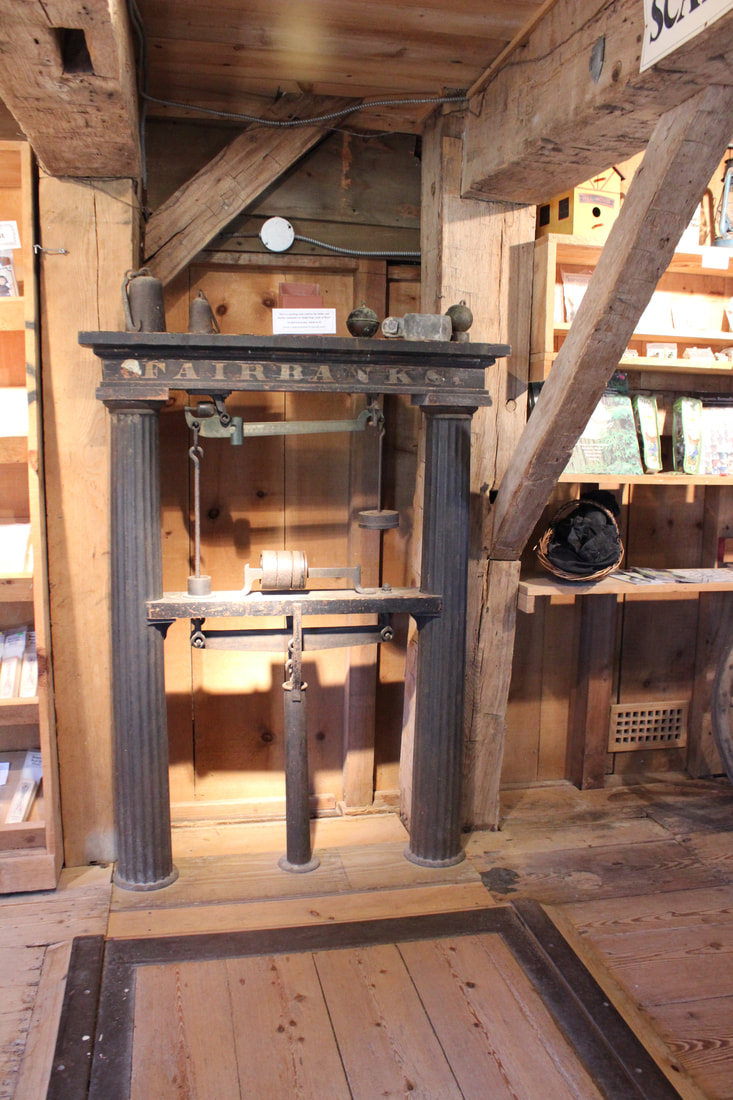
The grist mill scale, where the flour was weighed (c) travelincousins.com
|
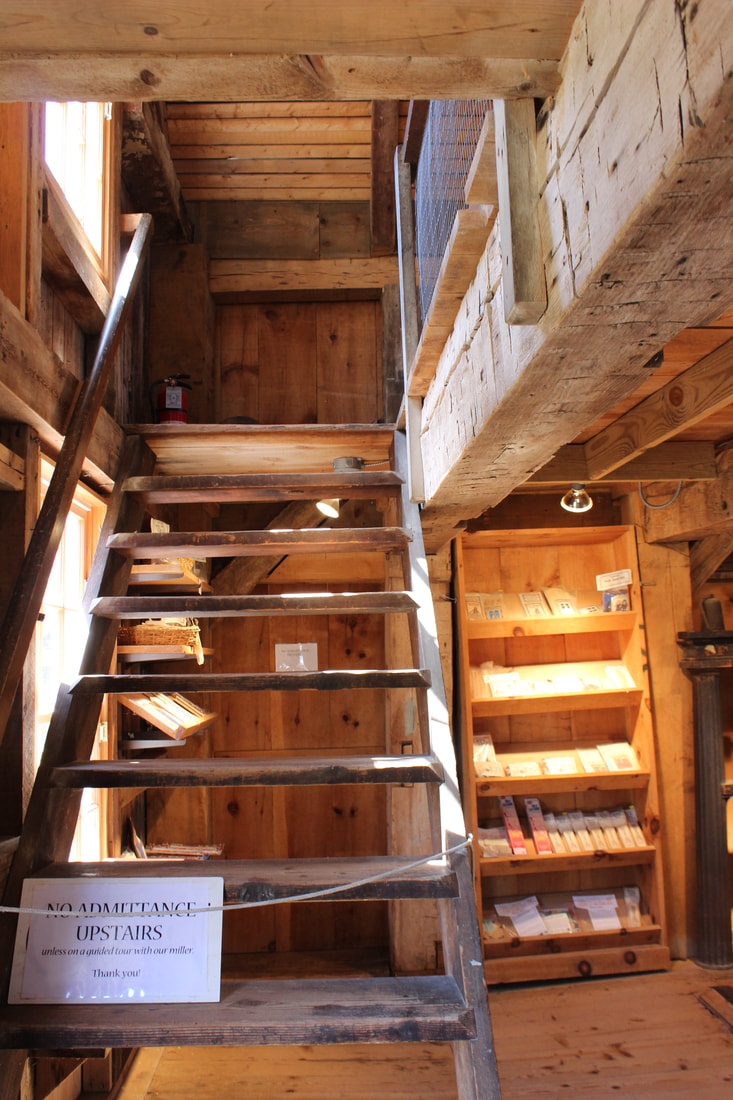
Steps leading up to the top floor - third level of the mill (c) travelincousins.com
|
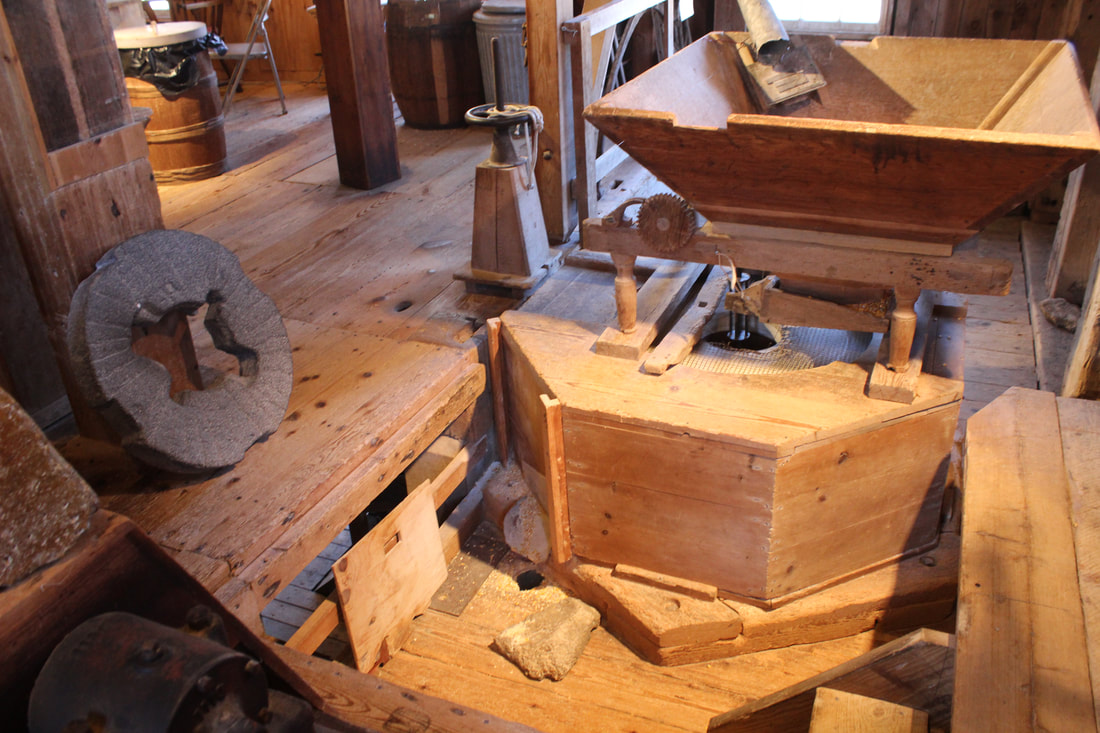
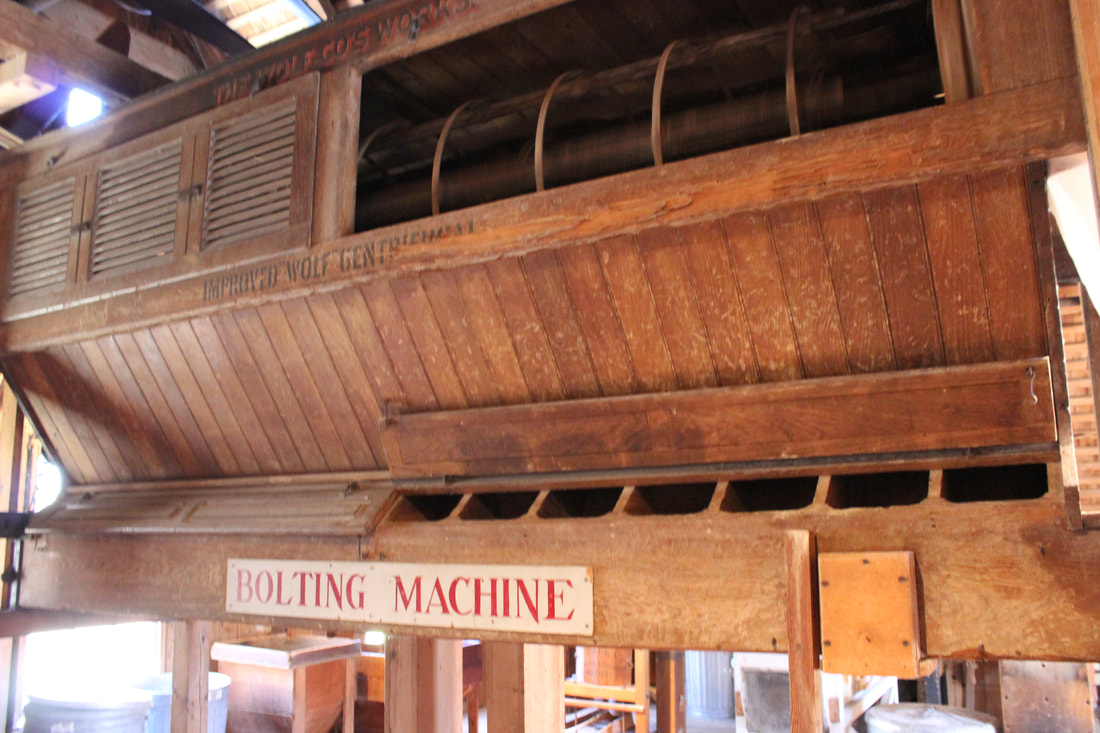
Our visit took us to all three levels of the mill, from the basement, where the grains were loaded to be milled, to the second floor or ground floor level, where they were ground by millstones, weighing up to one ton each; and finally up to the third floor to see the bolting process, where the sifting takes place to separate the flour from the leftover bits. The flour would go to the customer and the leftover bits would become feed for the animals.
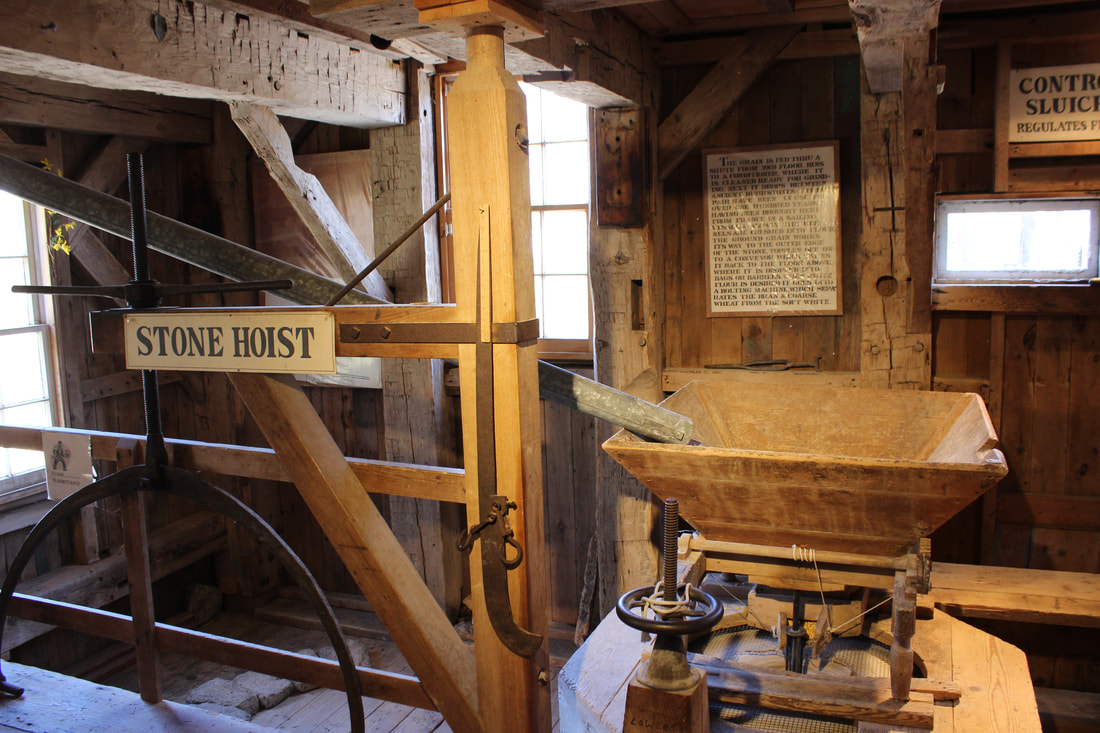
The grains come through the pipe into the giant bowl, where they pass through and are ground up by large stones that weigh about a ton each (c) travelincousins.com
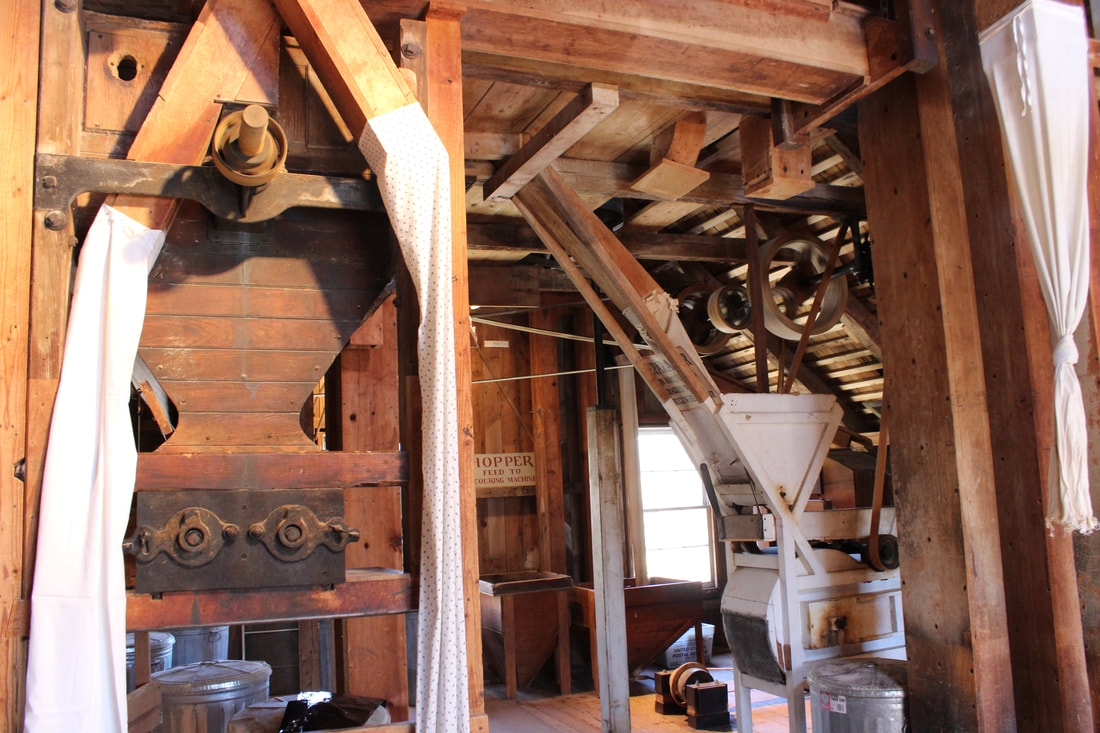
Third floor - Bolting process (c) travelincousins.com
|
After it is ground, it goes up a vacuum tube to the 3rd floor to the bolting area where the flour is separated or sifted from the larger pieces, which were used for feed for farm animals (c) travelincousins.com
(c) travelincousins.com
|
The entire mill and all of the machines are powered by water. Water from the millpond across the street flows under the street to the wheel, which powers the mill. It turns a series of gears and wheels, which turns the huge millstones, which in turn crushes and grinds the corn, wheat, rye or barley.
The mill backs up to the Stony Brook, which connects to the Stony River, by which ships would travel in order have their grain ground at the mill. An excellent location in those days for saving traveling time that would otherwise have to be brought by horse and carriage. (Incidentally, it is the Stony Brook from where this hamlet derived its name!).
The mill backs up to the Stony Brook, which connects to the Stony River, by which ships would travel in order have their grain ground at the mill. An excellent location in those days for saving traveling time that would otherwise have to be brought by horse and carriage. (Incidentally, it is the Stony Brook from where this hamlet derived its name!).
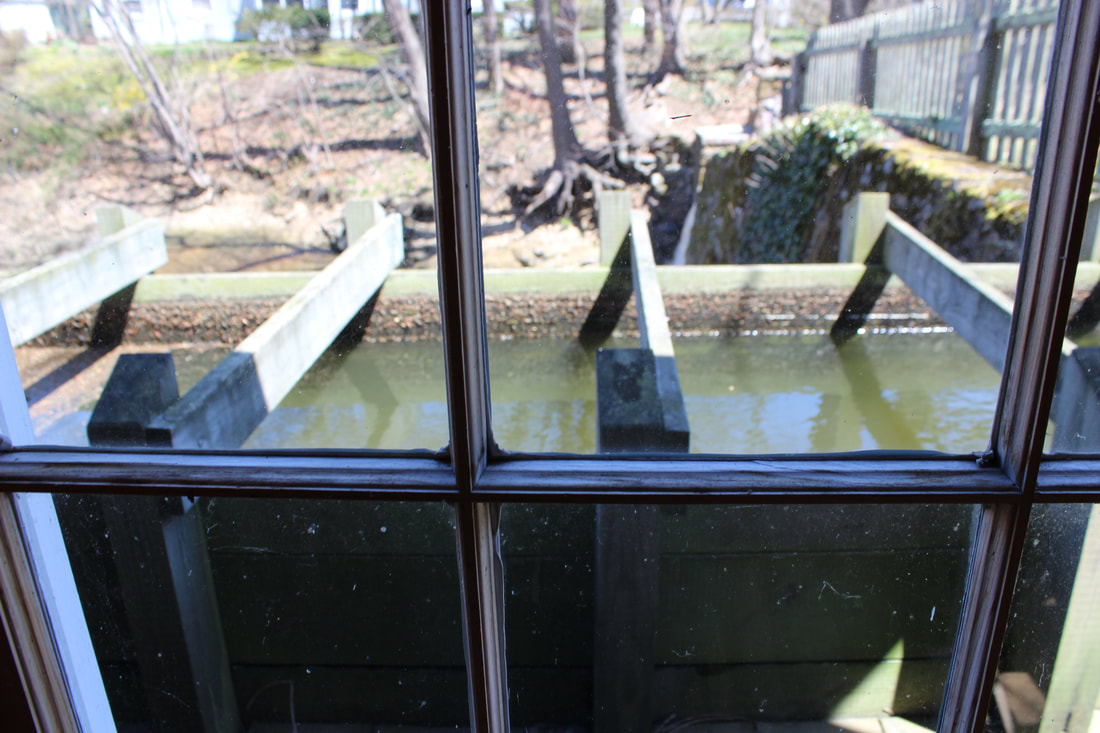
Water from the millpond across the street flows under the street to the wheel to power the mill (c) travelincousins.com
|
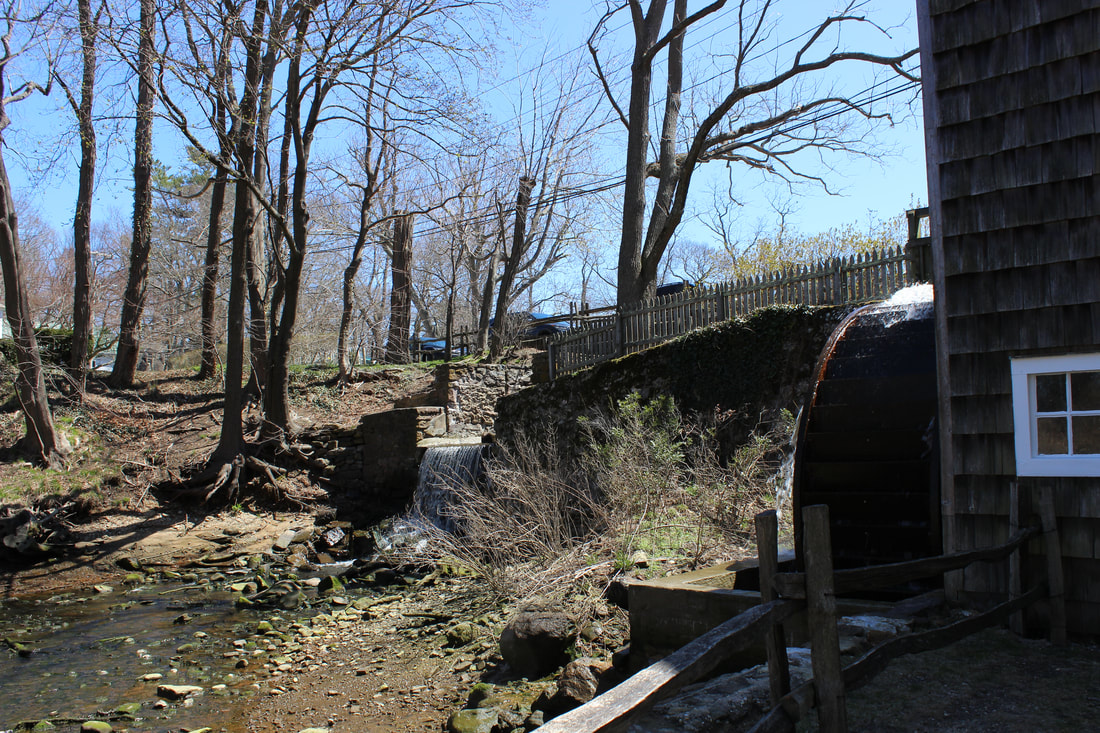
The turning wheel next to the building. The excess water run-off from the pond can be seen to the left, to keep the pond level (c) travelincousins.com
|
The shallow Stony Brook from Stony Brook Harbor where ships would sail to bring their grains to the mill (c) travelincousins.com
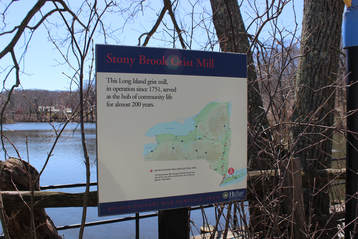
I'd like to share two bits of historic information. First, you may have noticed the photos above, feature two signs outside the mill; one stating that the mill has been in operation since 1751 and another, a marker denoting the site where Adam Smith built the Stony Brook Grist Mill in 1699. Two different dates for the same mill.
Well Adam Smith did indeed build the mill in 1699, but, unfortunately, a flood washed it away and required a new one to be built by his son in the current location in 1751. Richard, our tour guide advised us that many of the original beams from the first mill were used and still part of the framing on the current structure. These beams are massive and it is fascinating to behold the hand cut saw marks in the wood.
Well Adam Smith did indeed build the mill in 1699, but, unfortunately, a flood washed it away and required a new one to be built by his son in the current location in 1751. Richard, our tour guide advised us that many of the original beams from the first mill were used and still part of the framing on the current structure. These beams are massive and it is fascinating to behold the hand cut saw marks in the wood.
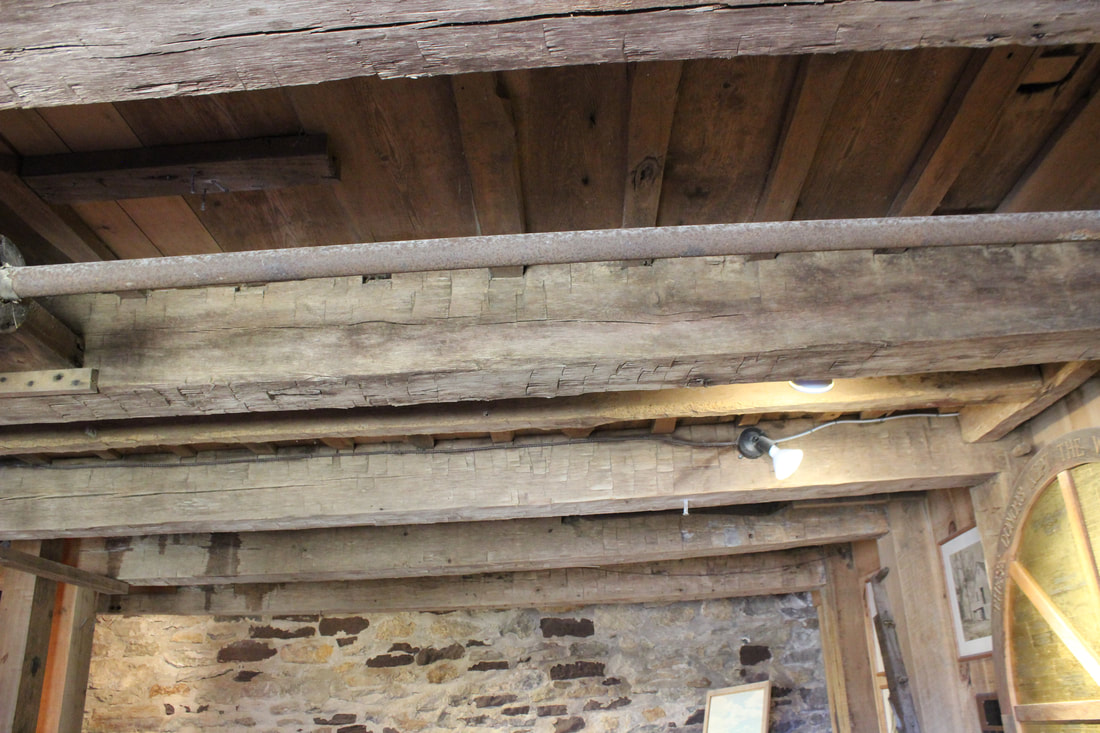
Original beam used in the current structure built in 1751 from the original grist mill built in 1699 by Adam Smith (c) travelincousins.com
The second bit of trivia concerns the flag hanging outside the Grist Mill. This flag is called the British Red Ensign. It came to America in the 1620's. In 1707, this flag was flown by the colonists and during the beginning of the Revolutionary War. This flag would have been in front of the mill when it was first built.
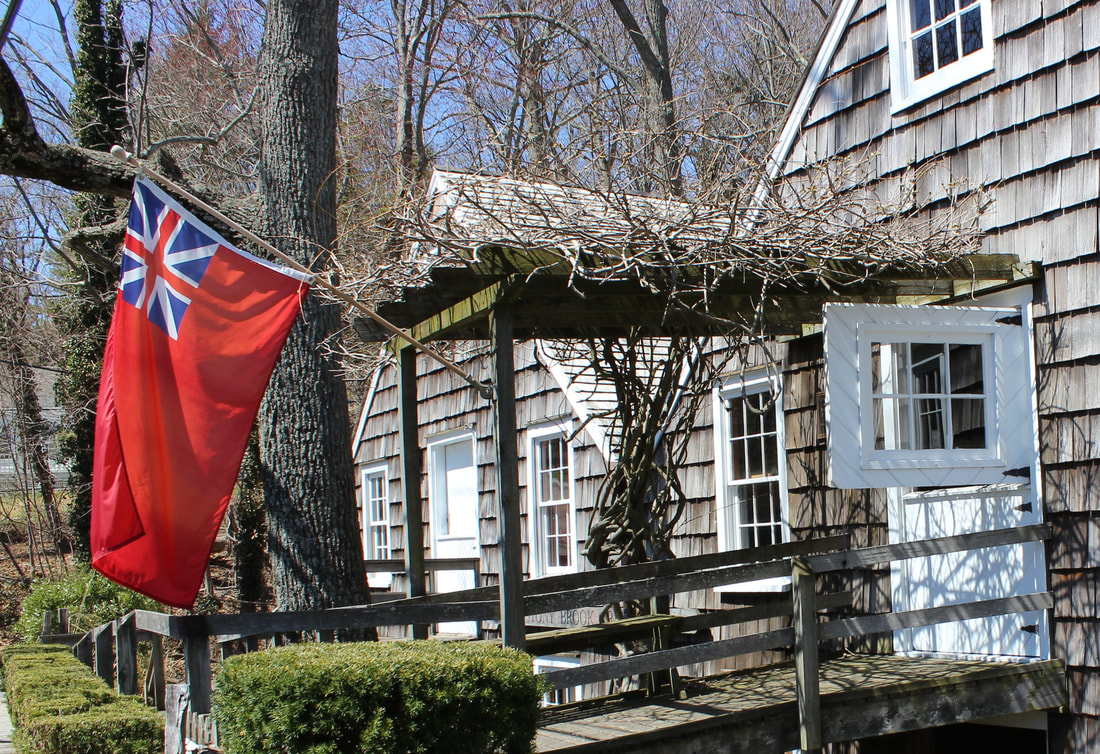
The British Red Ensign Flag flown in the colonies (c) travelincousins.com
The Stony Brook Grist Mill had over two dozen owners through the years since 1751, and the last person to take ownership was Ward Melville, who bought it in 1947 and gave it to the Stony Brook Community Fund in 1952, which is now the Ward Melville Heritage Organization.
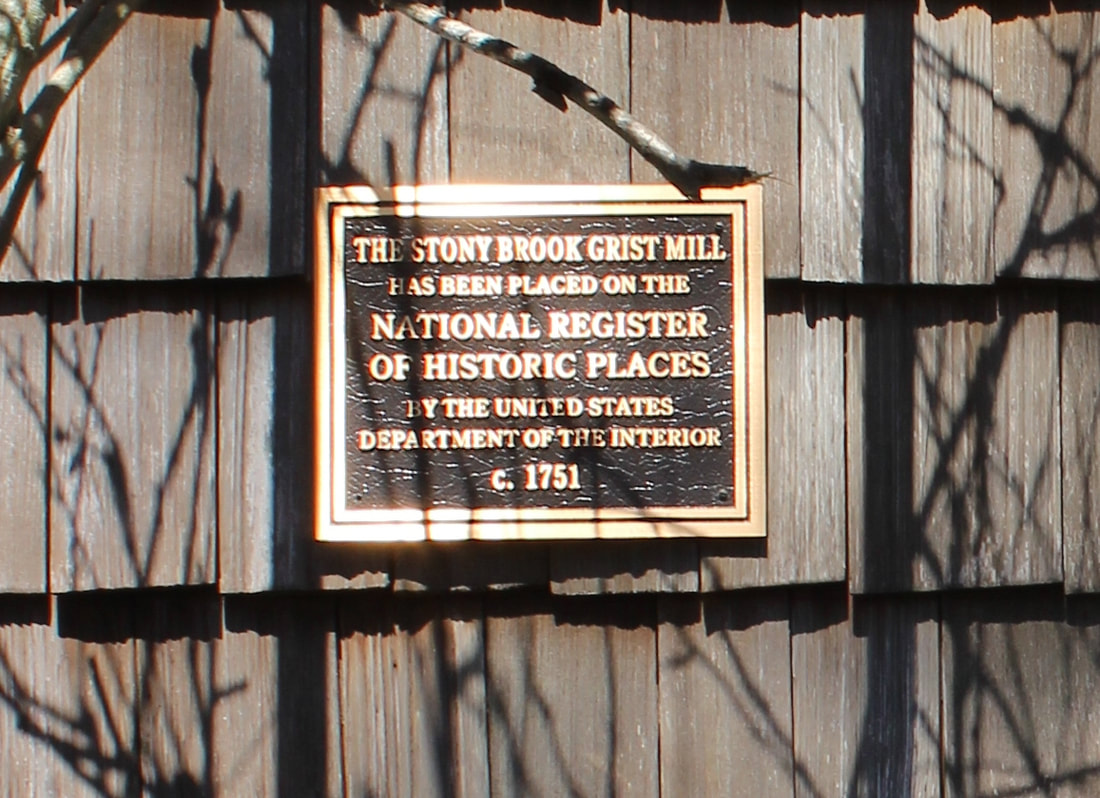
In the late 1960’s The Stony Brook Museums opened the Mill. In 1990, it was listed on The National Register of Historic Places.
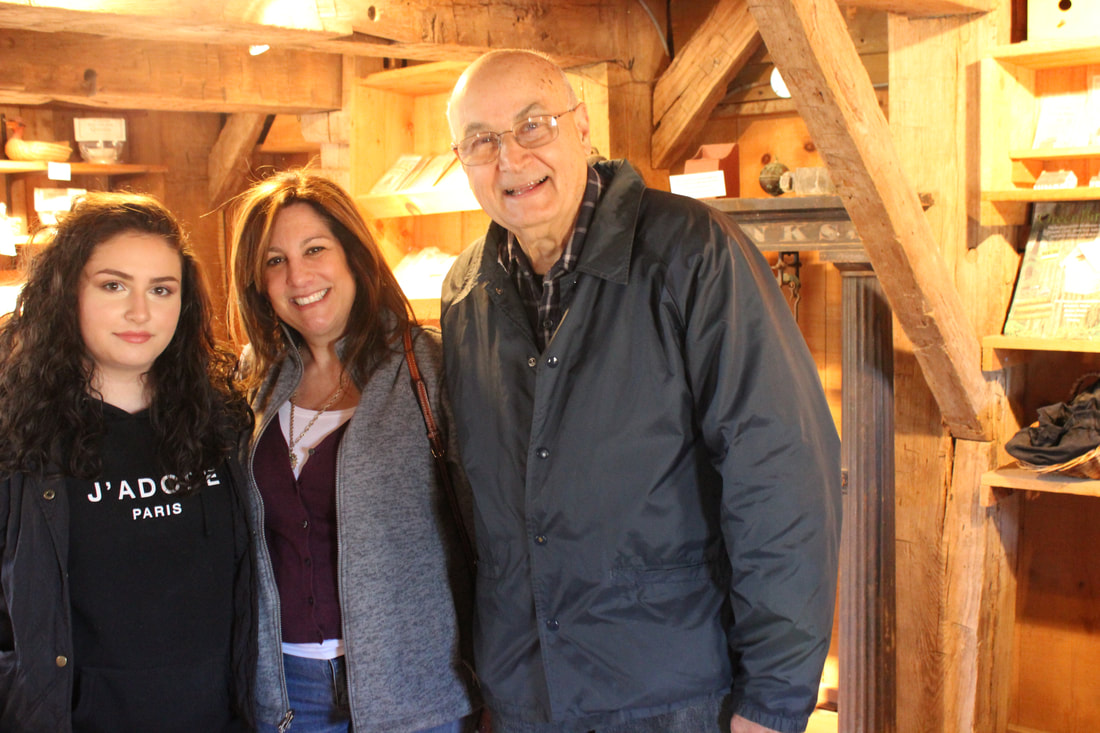
Gianna, me and Richard, our Stony Brook Grist Mill tour guide (c) travelincousins.com
I highly recommend visiting if you haven't already done so. It's a charming bit of American history!
-Elisa
-Elisa
For Your Reference
Stony Brook Grist Mill
100 Harbor Road, Stony Brook, NY 11790
(631) 751-2244
Saturday - Sunday : 12:00pm - 4:30pm
Stony Brook Grist Mill
100 Harbor Road, Stony Brook, NY 11790
(631) 751-2244
Saturday - Sunday : 12:00pm - 4:30pm

 RSS Feed